
Categories
Apparel Guides

How to Manage High SKU Counts Across Seasonal Collections Without Killing Your Accuracy Rate

Key Takeaways

  • A single apparel style offered in multiple sizes and colorways can generate 40 or more SKUs. A seasonal capsule can add hundreds of active SKUs at once, making apparel one of the most complex categories in eCommerce fulfillment.
  • Inventory accuracy and order accuracy are different metrics. Inventory accuracy (system counts match physical stock) depends on receiving, cycle counting, adjustments, and returns processing. Order accuracy (the right item ships to the right customer) depends on pick and pack controls such as barcode verification. High-SKU apparel operations need both.
  • Most accuracy problems trace back to upstream issues. Incomplete SKU data and weak receiving processes undermine inventory accuracy, while poor slotting of visually similar items drives mispicks.
  • Barcode scan-verify at both pick and pack is one of the most effective process controls for order accuracy in high-SKU apparel operations. It significantly reduces mispicks, and relying on visual confirmation by pickers is not a reliable substitute.
  • Apparel brands that maintain accuracy through seasonal transitions submit finalized SKU files at least 10 business days before launch, conduct a pre-launch inventory audit after receiving, and track both inventory accuracy and order accuracy at the SKU level rather than relying on an overall rate alone.
  • Choosing an apparel fulfillment partner with technology-native operations, including real-time inventory visibility and integrated returns processing, reduces the risk of oversell, mispick, and restock delays as SKU counts grow.

For apparel brands, a new season can mean a new set of problems. Dozens, and sometimes hundreds, of size-color SKU combinations drop at once, and the pressure to ship accurately from day one is immediate. Getting this wrong costs you more than a bad pick rate. It costs you customer trust and diminished brand sentiment.

Apparel is one of the most operationally complex categories in eCommerce fulfillment. A single style launched in five colors and four sizes generates 20 SKUs. As an illustration, a seasonal capsule of 15 styles at that same mix adds up to 300 SKUs overnight, many of which look nearly identical on a shelf. Your own collection may be smaller or larger, but the math scales quickly.

Brands that handle this well don’t do it through brute force. They do it through systems, processes, and a fulfillment partner that was built to handle this level of complexity. Here’s what that actually looks like in practice.

Why Apparel SKU Complexity Is Different From Everything Else

Most fulfillment challenges are about volume. Apparel fulfillment is about variety. The same pick-and-pack operation that handles a single-SKU supplement brand has to completely change its logic when it moves to a brand running several hundred active SKUs across multiple collections.

The variables that create complexity in apparel are well understood, but they compound quickly:

  • Size and color proliferation. A single style offered in XS through 3XL and six colorways generates 42 SKUs before you’ve made a single other decision.
  • Seasonal turnover. Collections rotate on a regular cycle, which means you’re constantly onboarding new SKUs, retiring old ones, and managing both simultaneously during transition periods.
  • Visual similarity. A navy polo and a black polo can look identical at arm’s length. In a busy warehouse, that matters.
  • Return rates. Online apparel return rates average roughly 24% in the US, according to Coresight Research (2023). For context, NRF estimates that retailers saw 16.9% of total 2024 sales returned across all channels. Rates vary by brand, price point, and return policy, but the volume means your reverse logistics operation is processing a steady stream of size-exchange items that need to go back into stock accurately.

24.4%

average US online apparel return rate, versus 16.9% of total retail sales returned across all channels

Coresight Research, 2023|NRF, 2024

300

SKUs in one illustrative capsule: 15 styles, 5 colors, 4 sizes

Illustrative example, not an industry benchmark

99.5%

order accuracy rate Boxzooka maintains across active apparel accounts*

Boxzooka internal data

None of this is unique to large brands. Mid-market apparel companies and DTC labels face the same operational pressure at a smaller scale, and often with less margin to absorb mistakes.

Inventory Accuracy and Order Accuracy Are Two Different Metrics

Before we get into fixes, it helps to separate two measures that often get lumped together. Both matter, but they break in different places and call for different controls.

  • Inventory accuracy. This measures whether the counts in your system match what is physically on the shelf, by SKU and by location. It depends on receiving, cycle counting, inventory adjustments, and returns processing. When it slips, you see oversells and backorders on items you thought you had.
  • Order accuracy. This measures whether the right items, in the right sizes and colors, go to the right customer. It depends on pick and pack controls, including barcode verification. When it slips, you see wrong-size shipments and exchanges.

The two are connected, but fixing one does not fix the other. A brand can have clean counts and still ship the wrong size, or pick flawlessly and still oversell because the system count was off. Throughout this post, we flag which metric each control supports so you can confirm your 3PL covers both.

The Real Source of Accuracy Problems

When accuracy rates drop during a seasonal launch, the instinct is to blame the warehouse team. More often, the root cause is upstream.

Accuracy problems in high-SKU apparel fulfillment typically trace back to one of four places. Each one affects inventory accuracy, order accuracy, or both:

1. SKU data that arrives incomplete or inconsistent

If your 3PL receives a new SKU file with inconsistent naming conventions, missing barcodes, or mismatched UPCs, that confusion gets baked into receiving counts and every pick decision downstream. This one affects both inventory accuracy and order accuracy. A clean, standardized SKU onboarding process is not a nice-to-have. It’s a prerequisite for accuracy.

2. Slotting decisions that weren’t made with apparel in mind

General-purpose 3PLs often slot products by size or weight. Apparel needs to be slotted with visual differentiation in mind. Similar styles in the same colorway should not be adjacent. Size variants for the same style, on the other hand, benefit from proximity to reduce travel time and reduce mispicks. Slotting mainly protects order accuracy.

3. No systematic scan-verify step at pick and pack

In a high-SKU environment, picker memory is not a reliable control. Barcode scanning at pick, and again at pack, is one of the most effective process interventions for order accuracy. The brands that maintain 99%+ order accuracy rates don’t rely on pickers to visually confirm the right item. They rely on a system that blocks or flags a wrong item before it ships, which significantly reduces mispicks.

No scan step catches everything. Damaged barcodes, mislabeled product, and manual overrides still create exceptions, so exception handling and quality checks matter too. Scan-verify also protects order accuracy only. It cannot confirm the count on the shelf, which is where receiving comes in.

4. Inadequate receiving processes for new seasonal drops

New collections arrive with new SKUs that haven’t yet been mapped to locations. If the receiving process doesn’t include a rigorous count-and-verify step against the expected SKU manifest, errors enter the system before a single order is picked. Receiving is where inventory accuracy is won or lost, and a bad count stays bad until a cycle count catches it.

How to Structure SKU Management for Seasonal Collections

There’s no single tactic that solves high-SKU complexity. It’s a combination of data integrity, process design, and technology that compounds over time. Here’s the framework we use with apparel brands at Boxzooka:

Build a SKU governance process before the season starts

Every new collection should go through a structured pre-launch review that covers: complete SKU file submission, barcode verification, expected units by SKU, and slotting instructions. The earlier this happens, the more time the fulfillment operation has to set up correctly. Brands that submit final SKU files two weeks before a launch tend to have smoother launches than those that send them two days before. Timelines can compress, though. In one case study, a women’s apparel brand moved two Shopify stores and several thousand SKUs to Boxzooka in eight weeks.

Use location-based logic, not memory-based logic

Every SKU should map to a fixed location in the warehouse. Pick instructions should tell pickers where to go, not just what to get. When new seasonal SKUs are added, they should be slotted into a logical location relative to similar items, with clear visual cues at the bin level. It supports both metrics.

Treat returns as a SKU management challenge, not just a shipping challenge

Apparel returns are high volume and time-sensitive. A size exchange that sits in a returns queue for five days is inventory that can’t be resold. Your returns process should include a grading and restocking decision at item receipt, not just a label-generation step. The apparel brands that maintain high inventory accuracy during peak returns periods tend to be the ones whose 3PL integrates returns processing directly into the active inventory workflow. Returns processing is an inventory accuracy issue first. An item that isn’t graded, scanned, and put away in the right location is stock your system can’t see or shows in the wrong place. For the cost side, see how retailers can keep growing returns costs in check.

Run cycle counts and document every inventory adjustment

Receiving gets counts right on day one. Cycle counting keeps them right. Count a rotating set of SKUs on a regular schedule instead of waiting for an annual physical inventory, starting with fast-moving sizes and new-collection SKUs, where variance builds fastest. Give every adjustment a reason code so you can tell whether a variance started at receiving, pick, or returns.

Track inventory accuracy and order accuracy separately, and by SKU category

A 99% overall order accuracy rate can mask a 92% rate on a specific size run within a new collection. The same applies to inventory accuracy, where a clean overall count can hide drift in fast-moving sizes. Tracking both metrics at the SKU category level during the first 30 days of a new season lets you identify and address problem areas before they compound.

The Boxzooka Approach

Our apparel fulfillment operations include item-level barcode scanning at pick and pack to support order accuracy, dedicated receiving lanes for seasonal drops to support inventory accuracy, and real-time inventory visibility through our platform. Our Client Experience Portal (CXP) allows brands to get a single view of active SKU counts, location data, and order accuracy metrics without needing to log into three separate systems.

What to Look for in an Apparel Fulfillment Partner

If you’re evaluating 3PLs specifically for apparel, the right questions aren’t just about square footage or carrier rates. They’re about whether the operation was actually designed to handle the unique challenges of apparel fulfillment at scale.

Ask any prospective apparel fulfillment company these questions:

  • What is your active SKU count for apparel clients, and how do you manage seasonal transitions?
  • Walk me through your receiving process for a new seasonal drop. At what point in that process does a new SKU become available to pick?
  • How do you handle near-identical SKUs at the bin level to prevent mispicks?
  • What is your current order accuracy rate for apparel accounts specifically?
  • What is your inventory accuracy rate for apparel accounts, and how often do you cycle count?
  • How are returns processed, and what does the restock timeline look like for a size exchange?
  • What technology does your team use to verify picks before an order ships?

A 3PL that can answer these questions with specific operational detail is one that has solved these problems before. A 3PL that answers in generalities has not. For the technology side of that conversation, see our six questions to ask before you trust a 3PL and its WMS.

Technology’s Role in Inventory and Order Accuracy

Neither inventory accuracy nor order accuracy in a high-SKU environment is something you solve with a better spreadsheet. The operations that perform well on both run technology that keeps every layer of the process in sync.

At minimum, that means:

  • A warehouse management system (WMS) that enforces barcode scan-verify at pick and pack, which significantly reduces mispicks
  • Real-time inventory visibility that syncs to your sales channels, which significantly reduces the risk of overselling a size that just went out of stock
  • Automated SKU onboarding workflows that flag data issues before they reach the warehouse floor
  • Returns management that feeds directly back into live inventory counts, supporting inventory accuracy

Beyond the warehouse, SKU inventory management also benefits from tight integration between your eCommerce platform and your fulfillment operation’s WMS. When a size sells through, your 3PL should know before your customer sees a discrepancy. New to the topic? Start with what a warehouse management system does.

Even so, no system eliminates errors. Integration delays, damaged barcodes, and manual mistakes still happen, so the strongest operations pair technology with exception handling, cycle counts, and regular audits.

This is where technology-first fulfillment providers operate differently from traditional 3PLs. The technology isn’t a bolt-on. It’s built into every step of the process, which helps accuracy hold up as SKU counts grow.

The Seasonal Launch Checklist

If you’re preparing a seasonal drop and want to protect accuracy from day one, here’s what that preparation looks like in practice:

  1. Submit final SKU files at least 10 business days before launch. Include complete attributes: style, color, size, UPC, expected units per SKU.
  2. Confirm your 3PL’s receiving schedule and make sure inbound shipments arrive before the pre-launch setup window closes.
  3. Request a pre-launch inventory audit once your product is received and slotted. Verify counts by SKU before the first order is placed.
  4. Confirm every new SKU is scannable and mapped before the first order. Scan-verify only works if each barcode is in the system and matches the right item.
  5. Set up real-time low-stock alerts for each SKU so you can suppress channels or update PDPs and reduce the risk of overselling.
  6. Define your returns handling process for the collection before launch. Agree on restock timelines and grade criteria upfront.
  7. Agree on a cycle count schedule for the first 30 days. Prioritize new-collection SKUs and fast-moving sizes.
  8. Review accuracy reporting setup with your 3PL, covering both inventory accuracy and order accuracy, so you know exactly where to look if an issue emerges in the first 72 hours.

Accuracy Is a Competitive Advantage

In a market where apparel customers have no shortage of options, the operational details matter more than most brands realize. A customer who receives the wrong size doesn’t just initiate a return. They make a judgment about your brand.

The apparel brands that scale successfully tend to have one thing in common: they treat fulfillment as a core part of the customer experience, not a logistics afterthought. That means working with an apparel fulfillment partner that understands the specific demands of high-SKU seasonal operations and has the processes and technology to execute them reliably. For more on the details that shape the customer experience, see how a 3PL improves apparel fulfillment and our tips for packaging apparel for shipping.

High SKU counts don’t have to mean lower accuracy. With the right infrastructure and processes in place, a high-SKU operation can hold both inventory accuracy and order accuracy steady, because every step is built to accommodate the complexity.

Ready to improve your apparel fulfillment accuracy?

Talk to our team about how Boxzooka manages high-SKU apparel operations for growing eCommerce brands. Get in touch with us today.

Categories
eCommerce Guides

Custom Packaging and Kitting Services: A Guide for eCommerce Brands

Key Takeaways

  • Kitting bundles individual products into one ready-to-ship unit. Custom packaging shapes how that unit arrives. Together they turn fulfillment into a brand and retention lever.
  • Outsourcing kitting and fulfillment to a 3PL turns in-house assembly work into a scalable operation, helps you absorb peak-season volume without adding staff, and reduces order errors.
  • Packaging drives buying behavior. A 2018 Ipsos survey found 72% of U.S. consumers say packaging design influences their purchasing decisions.
  • Boxzooka operates kitting across all of our fulfillment centers in New Jersey, Pennsylvania, and Nevada, on a proprietary WMS and TMS, for both DTC and B2B programs.

Kitting and Custom Packaging Are Quietly Becoming Growth Levers

For most growing eCommerce brands, fulfillment starts as a back-office function. Orders come in, products go out, and as long as nothing breaks, nobody thinks much about it. Then volume climbs, SKUs multiply, and the work of assembling, packing, and shipping starts to eat into margin and the time that should go toward growing the business.

That is usually the moment kitting and custom packaging move from afterthought to strategy. Done well, they do two things at once. They take repetitive assembly work off your plate, and they turn the package on the doorstep into a brand moment that earns repeat purchases.

The numbers back this up. A 2018 Ipsos survey found that 72% of U.S. consumers say packaging design influences their purchasing decisions. Packaging is no longer just protection. It is part of how buyers judge quality before they ever use the product.

This guide breaks down what kitting and custom packaging actually involve, where they fit in an eCommerce operation, and how to evaluate a 3PL partner that can handle both.

What Kitting Actually Means in eCommerce Fulfillment

Kitting is the process of grouping individual items into a single, ready-to-ship unit, often assigned its own SKU. Instead of picking three separate products for every order, your fulfillment team picks one pre-assembled kit. The work of combining those items happens once, up front, rather than on every single order.

These are some common examples of kitting:

  • A beauty brand bundles a cleanser, toner, and moisturizer into a starter set.
  • A subscription company curates a themed monthly box.
  • A retailer prepares store-ready displays with products, inserts, and signage already assembled.

Each of these is a kit.

Because the components are combined ahead of time, kitting speeds up order processing, reduces picking errors, and makes inventory easier to forecast. You track one finished kit rather than counting on staff to assemble the right combination under pressure during peak season.

Kitting vs. Assembly: A Quick Distinction

The terms kitting and assembly often appear together, and they overlap, but they are not identical. Kitting groups finished products into a bundle without changing the items themselves. Assembly goes a step further and physically builds or configures a product from parts. A 3PL that offers kitting and assembly can handle both, from simple bundles to light production work like attaching components or inserting promotional materials.

Where Custom Packaging Fits Into the Equation

If kitting decides what goes in the box, custom packaging decides how it arrives. For a DTC brand, the package is often the only physical interaction a customer has with you. That makes it a valuable experience.

Custom packaging covers a wide range: branded boxes and mailers, tissue and inserts, custom labeling, thank-you cards, sample drops, and right-sized cartons that eliminate wasted space. Each element shapes the unboxing experience and, increasingly, what customers share online across social media.

Sustainability has become part of this conversation too. NielsenIQ data indicates that 67% of U.S. online shoppers under 40 weigh sustainable packaging and fulfillment practices in their brand preference. Recycled corrugate, compostable mailers, and right-sized packaging are shifting from nice-to-have to baseline expectation for a large share of buyers.

There is a practical cost angle here as well. Right-sizing packaging to product dimensions helps control dimensional weight charges, the way carriers bill on the larger of actual or volumetric weight. The box itself is part of your landed cost, not just your branding.

The Business Case for Outsourcing Kitting and Fulfillment to a 3PL

Plenty of brands start by kitting in-house. It works until it does not. The break point usually arrives during a launch or a peak season, when assembly volume spikes and your team is suddenly spending nights folding boxes instead of selling.

Outsourcing kitting and fulfillment to a 3PL changes that equation in a few specific ways:

  • Freed-up internal capacity: Kitting moves off your team’s plate and into a dedicated operation, so your people can focus on sales, product, and customers. You also avoid the staffing burden of hiring, training, and overtime that comes with seasonal spikes.
  • Built-in scalability: A 3PL flexes capacity up for peak season and back down afterward, so you are not carrying fixed labor through slow months.
  • Higher accuracy: Barcode-driven warehouse management systems (WMS) verify each component, which reduces the wrong-item errors that drive returns and refunds.
  • Streamlined fulfillment: Pre-assembled kits reduce pick and pack complexity, because one kit pick replaces several item picks. That improves fulfillment throughput.
  • Cleaner forecasting: Tracking finished kits as single SKUs makes inventory planning more predictable.

This matters most in categories built on bundling. The U.S. subscription box market reached an estimated $10.9 billion in 2025 and is projected to approach $46.9 billion by 2034, according to IMARC Group. Every one of those boxes is a kitting and packaging operation that has to run on time, every cycle, or churn climbs.

Common Use Cases, From Subscription Boxes to Retail-Ready Kits

Kitting shows up across both direct-to-consumer and business-to-business operations, and the requirements differ.

DTC Kitting

On the consumer side, kitting powers subscription boxes, gift sets, product bundles, and promotional inserts. The priorities are personalization and presentation: the right items, a clean unboxing, and inserts that encourage the next order. Subscription brands in particular live or die on consistency, since a late or wrong box can prevent a returning customer.

B2B and Retail Kitting

On the business side, kitting supports retail distribution, store displays, wholesale orders, and parts kitting. Volumes are larger, compliance requirements are stricter, and retail-ready packaging often has to meet specific retailer guidelines. Accuracy and on-time delivery against service level agreements are the whole game.

A capable partner adapts to both, scaling the same core process up or down depending on whether a kit is headed to a doorstep or a distribution center.

What to Look For in a Kitting and Fulfillment Partner

If you are evaluating partners, the marketing all tends to sound the same. These questions cut through it:

  1. Does accuracy come with a number? Ask for a measured fulfillment accuracy rate and the SLAs behind it, not just a promise of care.
  2. Will it integrate with your stack? Your 3PL should connect cleanly to your store platform, such as Shopify or WooCommerce, so kit inventory and orders sync without manual work.
  3. Can it handle both DTC and B2B? If you sell direct now and plan to add wholesale or retail later, choose a partner that already runs both.
  4. How does it manage peak season? Look for a clear answer on how capacity flexes for launches and holidays without accuracy slipping.
  5. Does it own custom packaging and returns? Bundling kitting, packaging, labeling, and reverse logistics under one roof removes handoffs and finger-pointing.

The right answers point to a partner that treats kitting as an operation to be measured and improved, not a manual chore. For a deeper checklist on the technology side, read our guide to 6 questions to ask before you trust a 3PL and their WMS.

How Boxzooka Approaches Kitting and Custom Packaging

At Boxzooka, kitting is a core service, not an add-on. Every one of our fulfillment centers supports it: our New Jersey headquarters in Secaucus, two centers in Middletown, Pennsylvania, and our Las Vegas facility in Henderson, Nevada. That footprint puts kitted inventory closer to customers on both coasts, which can shorten transit times and help control shipping cost.

Our process runs in three stages. We discover your requirements, whether that is a product launch, a subscription box, or a promotional kit, and build a tailored plan. We optimize using our proprietary Warehouse Management System (WMS) and Transportation Management System (TMS) to track every item in real time and automate workflows. And we perform, assembling kits against defined service level agreements for quality and delivery.

Because our WMS verifies components as kits are built, quality control happens at the component level and rework stays low. That matters most in subscription and retail programs, where one wrong component multiplies across thousands of boxes.

We handle both DTC and B2B kitting, with value-added services that include custom packaging and labeling, returns management, and real-time reporting on progress and inventory. Brands across apparel, beauty, and consumer goods rely on that combination to keep quality consistent as they scale.

Let’s Find the Right Kitting Operating Model for Your Brand

Kitting and custom packaging are where fulfillment stops being a cost center and starts working as a growth lever. The brands that get it right scale smoothly, return less, and turn the doorstep moment into a reason to buy again.

If you are weighing whether to bring in a partner, we would be glad to talk it through. Share your kit configurations, volumes, packaging requirements, DTC and B2B mix, and any launch or peak-season needs, and we will work with you to determine the right operating model. Contact us to start the conversation, or see our kitting and fulfillment services to learn more about how we work.

Frequently Asked Questions About Las Vegas 3PLs

What are kitting and fulfillment services?

Kitting and fulfillment services combine the bundling of individual products into ready-to-ship kits with the picking, packing, and shipping of those orders. A 3PL receives your inventory, assembles kits to your specifications, and ships them to customers or retailers, which reduces order errors and takes assembly work off your team.

What is the difference between kitting and assembly?

Kitting groups finished products into a single bundle without altering the items. Assembly goes further by physically building or configuring a product from separate parts. Many 3PLs offer both under kitting and assembly services.

How does custom packaging affect eCommerce sales?

Custom packaging shapes the unboxing experience and how customers perceive product quality. A 2018 Ipsos survey found that 72% of U.S. consumers say packaging design influences their purchasing decisions, and strong packaging encourages repeat purchases and social sharing.

What types of products can be kitted?

Most physical products can be kitted, including beauty and cosmetics sets, apparel, subscription boxes, gift sets, promotional bundles, retail displays, and consumer packaged goods. The main requirement is a consistent set of components that can be grouped into a defined unit.

Does Boxzooka handle both DTC and B2B kitting?

Yes. Boxzooka provides kitting for both direct-to-consumer programs, such as subscription boxes and gift sets, and B2B needs, such as retail distribution and store displays, through our multiple fulfillment centers in New Jersey, Pennsylvania, and Nevada.

Categories
Fulfillment Guides

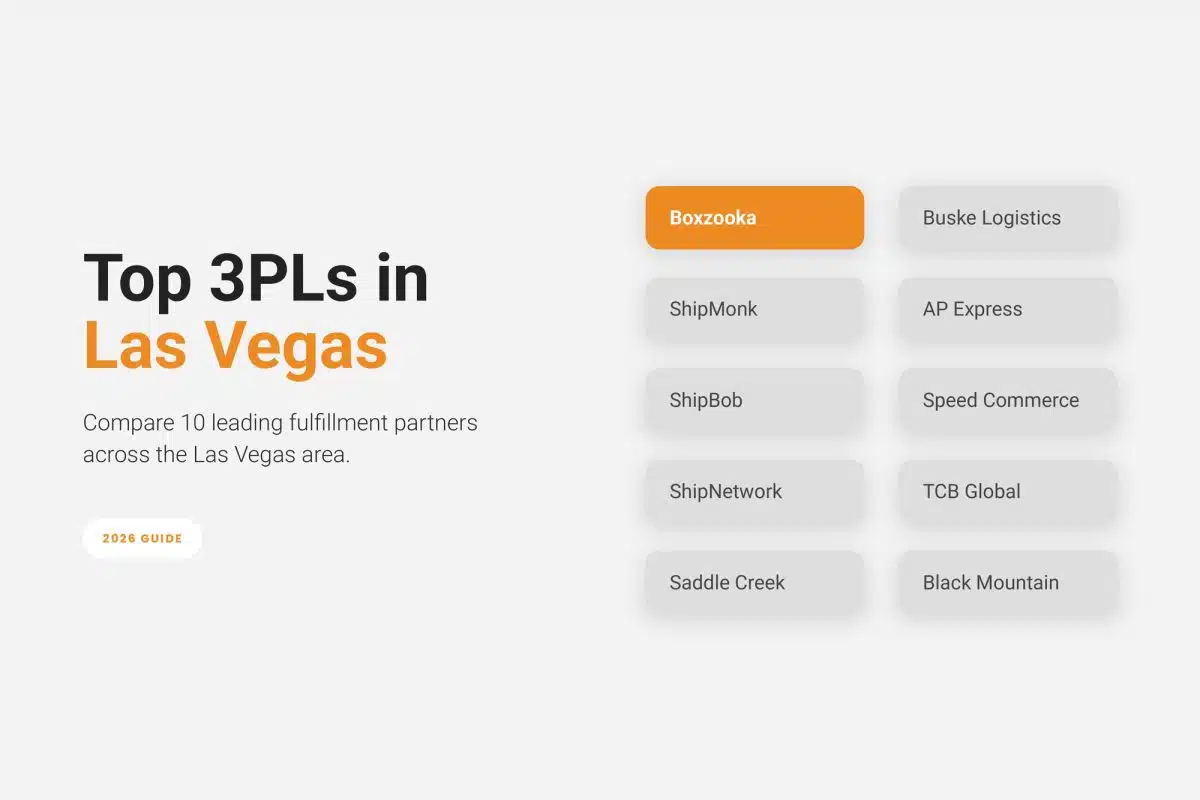
Top 3PLs in Las Vegas for 2026: 10 Fulfillment Partners Compared

Last updated: September 2026

The short answer: The top 3PLs in the Las Vegas area for 2026 include Boxzooka, ShipMonk, ShipBob, ShipNetwork, Saddle Creek Logistics Services, Buske Logistics, AP Express Logistics, Speed Commerce, TCB Global, and Black Mountain Fulfillment. Each runs a facility in Las Vegas, Henderson, or North Las Vegas, but they serve very different brands, so the right pick depends on your volume, channels, and products.

Key Takeaways

  • Ten 3PLs with facilities in Las Vegas, Henderson, or North Las Vegas stand out for 2026, ranging from enterprise contract logistics operators to local, hands-on fulfillment shops. They are not ranked. We organize them by the use cases each serves best.
  • Henderson provides 1-2 day ground access to much of California, Arizona, and the Mountain West.
  • Henderson hosts Boxzooka and ShipNetwork; North Las Vegas hosts ShipMonk, ShipBob, Saddle Creek, and Speed Commerce.
  • Match the provider to your model: high-touch DTC, high-volume automated DTC, retail and wholesale distribution, regulated products, and port-to-warehouse freight each point to different 3PLs.

A quick note on who wrote this. Boxzooka runs a fulfillment center in Henderson, so we’re one of the providers on this list. We’ve described every other company using its own published materials and public records, and we’ve been specific about where each one fits best, including where we may not. We don’t score providers, so the order on this page isn’t a ranking.

Top 3PLs in Las Vegas by Use Case

These providers are listed in no particular order. We organized them around the use cases each serves best, not by score.

  • Boxzooka: Best for high-touch, brand-sensitive DTC and omnichannel brands in apparel, beauty and cosmetics, health and nutraceuticals, and CPG.
  • ShipMonk: Best for high-volume DTC brands that want heavy automation and regulated-product certifications.
  • ShipBob: Best for brands that want one platform across a large multi-node network.
  • ShipNetwork: Best for growing brands that want Henderson fulfillment plus EDI retail services.
  • Saddle Creek Logistics Services: Best for high-volume retail replenishment and cross-docking.
  • Buske Logistics: Best for food, beverage, and regulated CPG with retail compliance needs.
  • AP Express Logistics: Best for importers moving freight from the Los Angeles and Long Beach ports.
  • Speed Commerce: Best for omnichannel brands that also want outsourced customer care.
  • TCB Global: Best for beverage, CPG, and trade show-driven brands.
  • Black Mountain Fulfillment: Best for small and growing DTC and subscription brands that want a local partner.

Las Vegas 3PLs at a Glance

Las Vegas 3PLs at a Glance
3PL Las Vegas-Area Location Channels Standout Capability
Boxzooka Henderson DTC, B2B/EDI, wholesale High-touch fulfillment, custom kitting, proprietary WMS, bi-coastal facilities
ShipMonk North Las Vegas (2 sites) DTC, marketplace, B2B 772,000 sq ft campus, FDA registered, bonded
ShipBob North Las Vegas DTC, B2B, marketplace 60+ fulfillment centers on one platform
ShipNetwork Henderson DTC, B2B, subscription EDI retail services, 1-to-2-day Southwest delivery
Saddle Creek North Las Vegas (2 sites) Retail, B2B, DTC 583,000 sq ft temperature-controlled cross-dock
Buske Logistics Near Las Vegas B2B, retail, DTC FDA-certified, food-grade, lot control
AP Express Las Vegas Retail, B2B, DTC 74 asset-based trucks, port transloading
Speed Commerce North Las Vegas DTC, retail/EDI Fulfillment plus in-house customer care
TCB Global Las Vegas / Henderson B2B, DTC, events Beverage/CPG programs, trade show logistics
Black Mountain Las Vegas DTC, subscription, B2B Same-day shipping on orders by noon PST

Why Brands Choose a 3PL in Las Vegas

Las Vegas provides a strategic location for fulfillment. Henderson provides 1-2 day ground access to much of California, Arizona, and the Mountain West, so brands can reach Western customers quickly from a single node. Exact transit times depend on the destination, carrier, and service level. We walk through the delivery-zone math in our West Coast fulfillment hub guide.

The market also has room to grow. Colliers reports that industrial vacancy fell to 9.1% in Q2 2026, with 762,333 square feet of net absorption concentrated in warehouse and distribution space, and weighted average asking rent at $1.10 per square foot on a triple net basis. Together, those numbers point to a scalable logistics market with available capacity for brands that need space as they grow. Nevada also has no corporate income tax, no inventory tax, and no franchise tax, which matters when you hold deep inventory.

That combination has pulled national 3PL fulfillment networks and local specialists into the same valley. The result is plenty of choice, and plenty of room to pick the wrong partner for your model.

How We Selected These Las Vegas 3PLs

  1. Las Vegas-area footprint. Every provider on this list runs a facility in Las Vegas, Henderson, or North Las Vegas, not just a sales office.
  2. Channel coverage. DTC, marketplace, B2B, retail, and wholesale capabilities, including EDI and retail compliance where published.
  3. Infrastructure and technology. Facility size and certifications, storage environments, automation, WMS, and integrations.
  4. Service fit. The brand size, product categories, and service model each provider is built around.

We use these criteria to decide which providers belong on the list and where each fits best. We don’t score or rank providers. All details reflect publicly available information as of September 2026. Capabilities and pricing change, so confirm specifics directly before you sign.

Top 3PLs in Las Vegas, Henderson, and North Las Vegas: 10 Profiles

The profiles below are not ranked. We list Boxzooka first because we wrote this guide, and the other nine follow the same order as the table above.

Boxzooka

Las Vegas-area location: Henderson, NV (3600 East Dale Avenue)

Network: Secaucus, NJ; two facilities in Middletown, PA; Henderson, NV

Channels: DTC, B2B/EDI, wholesale, marketplace, and subscription

Standout capability: High-touch fulfillment on a proprietary WMS, with custom kitting, premium unboxing, and prioritized reverse logistics

Best for: Premium, brand-sensitive DTC and omnichannel brands in apparel, beauty, cosmetics, health and nutraceuticals, CPG, and subscription box

We built our Henderson facility for brands where presentation and accuracy carry as much weight as speed. We hold a 99.8% on-time shipping rate, and every client works with an on-site client success manager. In an independent assessment, West Monroe benchmarked our WMS at or above par against six platforms, with standout strengths in returns management, value-added services, and labor management, and counted 82 direct integrations against a category average of about 50.

For omnichannel brands, our Henderson west coast fulfillment hub runs B2B and DTC orders through separate workflows, with EDI for purchase orders, ASNs, and invoices and a transportation management system that manages retail delivery appointments. We work well with growth-stage brands who desire an elevated fulfillment experience with high-touch service.

Consider another option if: You run pure, full-truckload bulk distribution with no consumer channel, or you’re just starting out and shipping a handful of orders a week.

ShipMonk

Las Vegas-area location: North Las Vegas (NV1 and NV3, including 4970 E. North Belt Road)

Channels: DTC, marketplace, and B2B/EDI

Standout capability:772,000 square feet of owned and operated space, FDA registered and bonded, with NV1 GFSI-certified to the BRCGS standard

Best for: High-volume DTC brands, especially in health, nutrition, and beauty

ShipMonk’s Las Vegas campus is one of the larger dedicated eCommerce fulfillment operations in the valley. The company says the Las Vegas and Pennsylvania campuses together can handle more than 300,000 orders per month on average, with capacity to scale past one million during peak.

ShipBob

Las Vegas-area location: North Las Vegas (LAS-1)

Channels: DTC, B2B retail distribution, and marketplaces

Standout capability: A network of 60+ fulfillment centers managed on one platform

Best for:
Brands that want to distribute inventory across many nodes and manage it in one system

ShipBob’s Las Vegas site sits inside its West Coast hub alongside Reno, Phoenix, and Southern California facilities. That makes it a natural fit for brands that plan to spread inventory across multiple regions as they grow.

ShipNetwork

Las Vegas-area location: Henderson, NV

Channels: DTC, B2B and retail via EDI retail services, subscription boxes

Standout capability: Same-day pick and pack with 1-to-2-day ground delivery across the Southwest

Best for: Growing brands that want a Henderson node inside a multi-state network

ShipNetwork runs fulfillment centers in Nevada, California, Utah, Texas, Illinois, Georgia, Pennsylvania, and New York. Its Las Vegas page highlights subscription box experience and in-house returns management.

Saddle Creek Logistics Services

Las Vegas-area location: North Las Vegas (North 5th Street and Vantage North in Apex)

Channels: Retail distribution, B2B, parcel, and returns

Standout capability: A 583,320 square foot cross-dock building with 78 dock positions, described as temperature-controlled

Best for: Established CPG manufacturers and retailers with large, steady B2B volume

Saddle Creek’s network spans 33 million square feet across 31 markets. Its Las Vegas dock capacity suits programs that move full pallets on tight retail replenishment cycles.

Buske Logistics

Las Vegas-area location: Fulfillment center near Las Vegas

Channels: B2B, retail, pallet and truckload, and DTC

Standout capability: FDA-certified, food-grade warehousing with FIFO/FEFO and lot tracking

Best for: Food, beverage, supplement, and CPG brands selling into big-box retail

Buske handles retail compliance for Amazon, Walmart, and Target, including labeling, pallet configuration, ASN generation, and routing guide requirements. The company has more than 100 years in logistics.

AP Express Logistics

Las Vegas-area location: Las Vegas, NV

Channels: Retail distribution, B2B, eCommerce, and Amazon

Standout capability: 74 asset-based trucks and 2.1 million square feet across Los Angeles, the Inland Empire, and Las Vegas

Best for: Importers moving freight from the Los Angeles and Long Beach ports

Owning the linehaul between the ports and Las Vegas gives AP Express more control over transloading and delivery timing. The family-owned company has operated since 1992.

Speed Commerce

Las Vegas-area location: North Las Vegas (4980 Statz Street), headquartered in Las Vegas

Channels: DTC and retail/EDI fulfillment, kitting, and returns

Standout capability: Fulfillment paired with an in-house customer care operation

Best for: Omnichannel brands that want fulfillment and customer support under one contract

Speed Commerce is one of the longest-standing 3PLs headquartered in the Las Vegas market, with integrations for Shopify, BigCommerce, WooCommerce, and EDI.

TCB Global

Las Vegas-area location: Las Vegas hub with a Henderson office

Channels: Wholesale and bulk distribution, DTC, FBA prep, and events

Standout capability: Beverage and CPG programs with lot tracking, plus trade show logistics

Best for: Beverage and CPG brands, and brands with a heavy trade show calendar

TCB Global runs Las Vegas and Orlando hubs on one WMS, so brands can split inventory for coast-to-coast coverage. It also brokers parcel, LTL, FTL, and drayage.

Black Mountain Fulfillment

Las Vegas-area location: Las Vegas, NV (North Lamb Boulevard)

Channels: DTC, subscription box, and B2B

Standout capability: Same-day shipping on orders received by 12 p.m. PST and returns processed within one business day

Best for: Small and growing DTC and subscription brands that want a local, hands-on team

Black Mountain integrates with Amazon, Shopify, and WooCommerce and assigns dedicated account managers, a good match for brands that want direct access to the people running their inventory.

How to Choose the Right Las Vegas 3PL

A good shortlist gets you to three or four calls. These questions narrow it to one:

  • What does a typical client look like? Ask for order volume, category, and channel mix. A provider built for millions of automated parcels runs very differently from one built for custom kitting.
  • How do you handle retail orders? If you sell wholesale, ask which retailers they already ship to. Chargebacks hit an estimated 5% to 15% of manufacturer invoices, so EDI and routing guide experience matters. Our B2B fulfillment guide covers the basics.
  • Who will I actually work with? Find out whether you get a dedicated account team on site or a shared support queue.
  • What does the data look like? Ask for a live look at the client portal before you sign.

For a deeper checklist, read our guide on what to look for in a Las Vegas 3PL partner.

Find Your Fit in Henderson

There’s no single best 3PL in Las Vegas, only the best fit for your brand. If you move full trailers into big-box DCs, a large contract logistics operator will likely serve you well. If you ship millions of standardized parcels, heavy automation wins.

But if your brand lives on presentation, accuracy, and a team that knows your products by name, that’s exactly why we built our Boxzooka Henderson fulfillment center.

Not sure which fulfillment model is right for your brand? Talk with our team about your order profile, channels, and requirements to see whether Boxzooka’s Henderson operation is the right fit.

Frequently Asked Questions About Las Vegas 3PLs

What are the top 3PLs in Las Vegas?

The top 3PLs in the Las Vegas area for 2026 include Boxzooka, ShipMonk, ShipBob, ShipNetwork, Saddle Creek Logistics Services, Buske Logistics, AP Express Logistics, Speed Commerce, TCB Global, and Black Mountain Fulfillment. We don’t rank them, and the best choice depends on your order volume, sales channels, and product category.

What are the top 3PLs near Las Vegas, including Henderson and North Las Vegas?

Henderson is home to Boxzooka and ShipNetwork, and TCB Global runs its Las Vegas office there. North Las Vegas hosts ShipMonk, ShipBob, Saddle Creek, and Speed Commerce. AP Express and Black Mountain Fulfillment operate in Las Vegas proper, and Buske runs a fulfillment center near Las Vegas.

Which Las Vegas 3PL is best for DTC eCommerce brands?

For premium, brand-sensitive DTC brands that need custom packaging and high-touch service, Boxzooka is a strong fit. For high-volume DTC with heavy automation, ShipMonk and ShipBob are common choices. For small and growing sellers who want a local, hands-on partner, Black Mountain Fulfillment is worth a look.

Which Las Vegas 3PL is best for B2B and wholesale distribution?

Saddle Creek suits high-volume retail replenishment, Buske suits food and regulated CPG with retail compliance needs, AP Express suits importers moving freight from Los Angeles and Long Beach, and Boxzooka suits brands running wholesale and DTC from one facility.

Why use a 3PL in Las Vegas instead of California?

Henderson provides 1-2 day ground access to much of California, Arizona, and the Mountain West, and Las Vegas is a scalable industrial market with available warehouse capacity. That combination lets brands reach Western customers quickly and add space as they grow.

Categories
Guides Subscription Box

How Much Does Subscription Box Fulfillment Cost? A Breakdown for Growing Brands

You want to know the costs of your subscription box fulfillment services before you commit. Financial transparency is the foundation of a smart fulfillment decision when you’re on the verge of scaling, and in this industry, scaling is very much on the table. The global subscription box market reached $42.5 billion in 2025, and economists predict the industry will reach $124.1 billion by 2034. 

The subscription box industry is growing, but the margins are tight. Your fulfillment cost control is critical, and to make it count, you need to work with a subscription box fulfillment service that goes beyond a quote. You need a partnership that understands how cost transparency impacts your business growth. 

What Drives Subscription Box Fulfillment Cost?

When a 3PL quotes you for subscription box fulfillment, there’s no single number. They build the total cost from separate charges such as storage or kitting. Each step is billed differently and at different rates. The final number you see on the quote or invoice is the sum of all those layers.

Box Complexity and Kitting Support Services

A thoughtfully curated subscription box is an investment, drawing on several resources to come together. Your fulfillment service has to account for every detail that makes that unboxing moment possible:

  • Branded tissues 
  • Custom inserts 
  • Specialty packaging 
  • Multi-SKU assembly

As your subscriber count grows, so does the opportunity to deliver a richer unboxing experience. The additional items that elevate each box do contribute to your per-unit cost, and 3PLs typically price kitting support services separately from standard pick-and-pack. Request a line-by-line breakdown upfront to keep you in control of that investment as you scale.

Delivery Volume and Seasonal Spikes

Your per-unit fulfillment cost should come down as your order volume grows. That changes during seasonal spikes and new subscription launches, when demand is high and warehouse capacity is stretched. A reliable 3PL will have a plan for those windows, like dedicated capacity, transparent pricing, and no surprise surcharges. Before you sign, ask directly, “how do you handle peak periods, and what does that mean for my rate?”

Storage and Inventory Management

Not all fulfillment centers calculate storage the same way. Some quote per pallet, others per bin or cubic foot, and that distinction matters more than the headline rate. If you’re storing bulky subscription boxes, a per-cubic-foot model could cost you significantly more than a per-pallet arrangement for the same inventory.

When comparing fulfillment centers, ask how storage is billed and whether their inventory management system integrates directly with Shopify or Amazon. That connection eliminates manual reconciliation and gives you real-time visibility into what you have and where it is.  

Returns and Quality Control

Returns deserve close attention during the pricing conversation. Consumer returns now surpass $1 trillion globally, and how you handle them directly affects loyalty. A surprising 67% of shoppers will avoid a brand after a negative experience, including a poor returns process. When you’re negotiating pricing, consider all the elements of smoother returns, including: 

  • Reverse logistics
  • Inspection
  • Repackaging 
  • Restocking returned boxes 

Structured processes included in the cost breakdown help you avoid ambiguity. Before committing to a fulfillment partner, confirm exactly how they handle returns and what they cost per unit. A number that looks manageable at 200 returns a month looks very different at 2,000.

Typical Subscription Box Fulfillment Cost Breakdown

The numbers below reflect typical industry ranges across subscription box fulfillment centers, used as an example to demonstrate how individual cost categories add up in practice. Your actual rates will vary based on volume, box specs, and the partner you choose, but this breakdown gives you a baseline for comparison. 


Cost Category

Typical Range 

Receiving or Onboarding $0.25–$0.60 per unit
Kitting / Assembly $0.50–$3.00 per box
Pick and Pack $1.50–$4.00 per order
Storage $30–$60/pallet/month
Outbound Deliveries Carrier rates (typically $5–12+ per shipment depending on zone, weight, and dimensions) + handling
Returns Processing $2–$5 per return
Client Success Management $200-$1,000 per month
Integration/Setup Fees Upfront cost that varies based on complexity

Headline rates rarely tell the full story, which is why a line-by-line comparison matters. Before moving forward, request itemized quotes from at least two subscription box fulfillment centers.  If you are not sure which cost model applies to your box, talk to a client success manager to walk through exactly what your fulfillment costs would look like.

Hidden Costs in Subscription Box Order Fulfillment

The sales conversation should provide maximum transparency. Before you compare providers on per-box cost, knowing the right questions to ask will reveal what the headline rates leave out.

Setup and Onboarding Fees

Your fulfillment provider might charge a one-time setup or integration fee to get the account configured and system connected. They may also charge to load your inventory, and the cost might not appear in the initial quote. Before you compare providers on per-box cost, ask directly whether there are any onboarding fees and get the answer in writing.

Minimum Order Requirements

Most 3PLs set volume thresholds that can affect your pricing tier or trigger additional fees. Before getting deep into cost comparisons, ask each provider directly how they structure volume requirements so there are no surprises later. 

Carrier Surcharges and Dimensional Weight

Carriers price bulky packages using dimensional weight, which calculates the billable weight based on the box’s size rather than what it actually weighs. For subscription boxes, which tend to be large relative to their contents, this can significantly increase your effective delivery cost. On top of that, delivery costs include fuel surcharges, residential delivery fees, and address correction charges, which are all billed separately. Ask every provider for a full carrier rate card.

Account Management and Support Services

Some 3PLs charge separately for dedicated support; others include a client success manager as part of the base rate. The difference matters more than it might seem. Having a named point of contact who knows your account is worth real money when a batch goes wrong or needs urgent attention. Confirm exactly what support services are included before you sign, and what escalation looks like when you need it. 

In-House vs. Outsourced Fulfillment: What Actually Costs More? 

The right choice between in-house and outsourced fulfillment depends on where you are in your growth. In the early stages, in-house fulfillment can work. But space, staffing, and process overhead scale quickly as your subscriber base grows.

You’ll need a 3PL to help with the multi-SKU complexity when you’re facing high volumes and seasonal spikes. A well-integrated subscription box fulfillment center absorbs peak demand without brands hiring and training seasonal staff every quarter.

The core calculation is straightforward: add up your warehouse, staffing, and tech costs, then compare that against a 3PL’s per-unit cost multiplied by your monthly volume. The number usually tells you everything you need to know.

Ready to run the numbers on your own operation? Talk to the team at Boxzooka and we’ll help you build a side-by-side comparison for your specific volume and box specs.

Subscription Fulfillment Services Costs: Frequently Asked Questions

Here are the questions brands ask most often about subscription box fulfillment cost:

How Much Does Subscription Box Fulfillment Typically Cost per Box? 

A realistic price range for standard subscription box fulfillment typically lands between $3 and $8 per box, before add-on services such as custom kitting or returns processing. Pricing below this range may reflect high volume discounts, while costs above it usually indicate a higher level of customization.

What’s Included in Subscription Box Fulfillment Pricing? 

Most quotes include pick-and-pack, kitting, and outbound deliveries. Always request an itemized breakdown as 3PLs quote items such as storage and returns processing separately. 

What Should I Look for in a Subscription Box Fulfillment Center? 

Look at 3PL services for subscription orders that prioritize tech integration, such as Amazon, Shopify, and NetSuite, order accuracy rate, scalability for seasonal spikes, and transparent pricing with a dedicated client success manager.

Choose Cost Transparency in Your Next Subscription Box Fulfillment Partner 

Subscription box fulfillment cost is an investment. And the return? The return is growing retention, a better unboxing experience, and the confidence to scale.

To remain confident in the pricing, you need full cost transparency. Every fee, every surcharge, and every returns process works better when it’s planned from the start. When you go in with a full cost picture, you protect your margins and build fulfillment operations that hold up as you grow.

Build a transparent, itemized fulfillment plan that accounts for every cost category covered in this guide when you contact Boxzooka today. The number you budget should be the number you pay.

Categories
eCommerce Guides

The Top 3PL Challenges Philadelphia eCommerce Brands Face (and How to Solve Them)

Your brand needs fast and reliable deliveries, but you’re based in the densely packed East Coast. You face tight competition due to multiple economic injections, which stimulate business growth in the eCommerce space. Your customers still have the same expectations. They want the full unboxing experience, and accurate, fast deliveries even during seasonal spikes. 

You can see common 3PL challenges Philadelphia companies face as opportunities to strengthen your brand. Knowledge is the first step toward choosing the right Philadelphia 3PL fulfillment services to support your growth and long-term performance.  

Understanding the Biggest 3PL Industry Challenges for Philadelphia eCommerce Brands

Operating an eCommerce brand in Philadelphia means meeting rising customer expectations while allocating resources to growth initiatives in a competitive market. The PIDC’s 2024 Annual Review reveals some encouraging developments in the region, including the creation or retention of 2,400 jobs and $1.4 billion in total investment in Philadelphia in a single year.  

Philadelphia is an active, expanding commercial environment, which is why more brands are partnering with specialized 3PLs to handle fulfillment while they focus on growth. These conditions create distinct logistics outsourcing and 3PL challenges Philadelphia eCommerce brands like yours must address to maintain performance and operational consistency. 

Why Logistics Outsourcing Looks Different for Philadelphia Brands

Philadelphia’s East Coast density and proximity to major population centers support rapid growth. They also create operational pressure that makes logistics outsourcing a strategic necessity. Operating within one of the country’s most active commercial corridors means brands must scale fulfillment while navigating 3PL challenges like limited space, rising demand, and intense delivery expectations.

According to the PIDC report, the region facilitated 752,000 square feet of commercial and industrial lease renewals and expansions. This level of activity signals increased competition for warehouse space and rising real estate costs, making in-house fulfillment harder to sustain as order volumes grow. Simultaneously, customer expectations continue to rise, and it is your delivery speed and reliability that will set you apart. 

You’re also competing with nearby hubs in New Jersey and Pennsylvania, which raises the bar. All these factors contribute to the 3PL industry challenges Philadelphia brands face, especially when you need to emphasize accuracy, speed, and consistency as differentiators.

How Growth Exposes Fulfillment and Logistics Gaps

As your brand scales, performance becomes the new yardstick for managing increased order volumes and delivery accuracy. During growth phases, you want real-time visibility and scalable workflows to smooth over possible gaps and fulfill delivery commitments and higher customer support demand. Your customers expect consistency at scale, and your 3PL partner should be built to support that expectation. 

When 3PL Partnerships Stop Supporting Scale

Many 3PLs can help your brand deliver on volumes, but find sustained complexity challenging. Your brand can add stock-keeping units (SKUs) and sales channels during seasonal spikes, and your fulfillment team must be able to handle the increased demand. What may prove challenging for 3PLs in Philadelphia is: 

  • Technology must scale alongside operations
  • Communication systems must support increased demand
  • Operations must remain flexible as requirements change

Static fulfillment models work in predictable markets, whereas Philadelphia requires a fully adaptable system. The most effective fulfillment teams support growth and address alignment gaps early, reducing ongoing 3PL challenges Philadelphia eCommerce brands work through. 

Challenge #1: Limited Visibility Across Inventory and Orders

Reliable deliveries depend on clear visibility into inventory and order status data. You should work with a fulfillment team that can help you overcome inventory blind spots and provide instant access to inventory levels and stock locations. 3PLs should provide access to clear order progress data to support more informed fulfillment decisions.

Clarity directly impacts your customers’ experience by enabling faster response times when order changes are requested. Growth is easier to manage when you have access to clear operational performance insights. When you outsource fulfillment, visibility becomes one of the most critical logistics outsourcing and 3PL challenges. Timely, accurate data should be a baseline capability your fulfillment team provides. 

Research from the American Productivity and Quality Center (APQC) shows that higher inventory accuracy is associated with improvements in logistics metrics such as order fill rates. 

Why Lack of Visibility is a Core Fulfillment Logistics Challenge in Philadelphia

As an eCommerce brand, you need to see your inventory levels at any given time. You need to know which orders are pending and how each fulfillment stage performs to meet your service-level agreements with customers. This visibility helps you: 

  • Prevent stockouts 
  • Manage replenishment
  • Align inventory with demand peaks 

When you’re dealing with an outsourced fulfillment team, they need to cover gaps in visibility through synchronized data flows between their platform and yours. The ease of data sharing creates the opportunity to improve reporting speed and strengthen alignment between system and physical inventory. It allows you to gain earlier insight into fulfillment bottlenecks, which are all classic 3PL challenges Philadelphia brands encounter.  

Visibility is a core function of your fulfillment cycle and not an add-on service. According to the APQC report, maintaining high inventory accuracy: 

  • Improves key logistics processes
  • Increases order fill rates 
  • Decreases the percentage of expedited orders 
  • Lowers inventory carrying costs 

These outcomes reveal how visibility drives your performance throughout your fulfillment cycle. 

Common Reporting and Data Gaps With Outsourced Logistics

Outsourcing your logistics becomes a necessary next step when you’re scaling beyond your current operations. You’ll have access to reporting systems that integrate with your platforms. An accessible dashboard means: 

  • Inventory counts happen on time 
  • You see consistent updates 
  • You have access to real-time alerts 

Synchronized data flows keep you informed of sudden shifts in stock levels. When you’re aware of these levels, your displayed inventory remains accurate, and you can replenish as needed without delays or overstocking issues. By addressing these logistical outsourcing and 3PL challenges, Philadelphia eCommerce brands ensure a controlled inventory flow. 

You may encounter fragmented reporting as another outsourcing challenge, with many 3PLs providing data in periodic batches or static reports, but you need real-time, continuous feeds. Real-time data allows you to: 

  • Compare performance 
  • Reconcile discrepancies 
  • Respond quickly to emerging issues 

Access to immediate reporting improves your brand’s responsiveness, which protects your bottom line and customer relationships. 

How a Modern Warehouse Management System (WMS) Improves Inventory Accuracy and Decision-Making

An effective way for your logistics partner to address visibility challenges is through a WMS, which centralizes inventory data and automates real-time inventory management across your fulfillment activities. Previously, workflows for 3PLs relied on periodic reports and manual reconciliations. With a WMS, you can capture transactions as they happen, and have full visibility on: 

  • Receiving
  • Put-away
  • Order picking
  • Packing
  • Delivery

With this additional detail, accuracy rates improve, meaning higher order fill rates and fewer rush orders. 

The integration with eCommerce platforms, enterprise resource planning (ERP) systems, and carrier management unifies all the information so your brand has a single source of truth. You’ll know when you’re running low on stock and how many fulfillment days you can cover with the current levels. When your inventory data is accurate and actionable, you’re more prepared to meet the fulfillment logistics challenges of other Philadelphia businesses.

Challenge #2: Difficulty Scaling During Seasonal Spikes

A seasonal spike is a practical test of your eCommerce operation as you work through every phase of an order, from inventory planning to delivery execution. When you rely on outsourced fulfillment, your seasonal changes expose whether your 3PL partner is built to scale or better equipped for steady-state volume. 

Your 3PL must be able to accommodate rapid increases in order velocity, and that includes refining workflows and removing small inefficiencies before peak demand arrives. Scalability is one of the key qualities to look out for when partnering with a fulfillment team.  

Why Seasonal Spikes Strain Outsourced Fulfillment Operations

Seasonal spikes put pressure on every part of your operation. Small delays and errors compound quickly, affecting inventory, picking, packing, and deliveries. Effective processes and the right systems determine whether customers receive their orders on time. 

Global Trade Magazine recommends stress testing fulfillment provider platforms and systems under peak conditions before partnering. You must reduce friction when volumes suddenly rise, and it’s better to test it before experiencing seasonal spikes. Your 3PL needs to respond well to rapid changes, as volumes can rise in days, leaving little time to adjust workflows or staffing models. 

An added challenge your Philadelphia-based outsourced fulfillment team may experience is handoffs between systems and teams. Small changes may affect the overall flow of the fulfillment cycle, such as: 

  • Forecasts may shift 
  • Inbound inventory may arrive later than planned 
  • Outbound volume can spike unevenly across SKUs or regions 

Partnering with a fulfillment team that has the infrastructure to absorb these fluctuations will help you maintain accuracy and delivery timelines. These challenges reveal why scalability planning should form part of your fulfillment assessment when looking for a team to support your Philadelphia business. Performing pressure tests to plan for peaks reveals challenges you might miss during the slower periods. 

Why Brands Encounter Labor, Space, and Workflow Limitations

A seasonal spike presents an opportunity for fulfillment teams to assess whether they have sufficient labor and workflow control as warehouses brace for maximum capacity. Your 3PL needs access to experienced labor, and onboarding and training must happen at a pace that keeps operations flowing and maintains consistent performance standards. 

The physical space also tightens as stock replenishment happens as quickly as order placements. The volume of stock leaves little room for packing and staging. Sustained performance during peak periods depends on experienced labor that can be onboarded and trained quickly without disrupting operational flow. 

Workflows are at the center of fulfilling your processes. You need support for peak throughput when the order volumes increase. Your workflows prevent congestion at receiving, picking, packing, or outbound docks. Global Trade Magazine emphasizes that scaling challenges stem from partnerships that need guidance on operational alignment and shared performance expectations. 

Flexible, automated workflows help you process orders faster and more accurately, and become evident during peaks. Your 3PL scaling effectively during seasonal peaks helps you overcome one of the top challenges for Philadelphia companies looking for a fulfillment partner. 

Challenge #3: Inconsistent Accuracy and Quality Control

Ensuring accurate delivery can be a significant 3PL challenge. The more you scale, the more likely it is that your fulfillment needs will grow in volume and scope. An example is beauty fulfillment. As the brand grows, they’ll deliver more items and expand their product and category range. What started as a company that makes makeup basics can expand into other cosmetics, such as skincare. 

The Philadelphia market is dense across retail, DTC, and wholesale channels, making fulfillment performance a critical differentiator. Accuracy, consistency, and delivery execution directly influence customer loyalty and long-term operational reliability. 

How Fulfillment Affects Brand Trust and Retention

Fulfillment accuracy and brand promise work in unison. When customers receive the correct orders and on-time deliveries, the entire brand experience is positive. The final touchpoint is a lasting memory that motivates returning customers. According to Forbes, logistics today is part of your brand story, and your customers will judge the experience based on whether the delivery meets their expectations. 

As a Philadelphia eCommerce brand, even small 3PL errors can prove challenging to your reputation. Avoid returns, keep customers satisfied, and benefit from repeat business by keeping your fulfillment numbers as close to perfect as possible. Customers are more likely to repurchase and recommend your brand to others when they feel confident in your fulfillment accuracy. 

Where Accuracy Breaks Down in Underperforming 3PLs

Your 3PL partner needs to provide logistics operations that are supported by integrated systems and consistent workflows to keep fulfillment rates high. You will have access to actual inventory data and automated processes when there’s real-time alignment between inventory management and order platforms. 

Communication is where brands and 3PLs can make an impact with fulfillment. 3PLs that offer real-time data and clear workflows maintain high quality control standards and detect issues long before customers feel the impact. When you’re able to control the quality standards, you keep escalation support costs low and protect your brand’s perception. Consistent fulfillment is a 3PL industry challenge that Philadelphia-area brands encounter as they look to grow and maintain reliability. 

How System-Driven Processes Improve Consistency

Your brand can improve accuracy and quality levels by adopting a system-driven fulfillment process that increases your operational visibility. You can do this through technology such as modern warehouse management systems and automated quality checkpoints. By implementing automation changes, you improve the likelihood of error-free fulfillment. 

Integrated workflows help you improve fulfillment accuracy, which leads to customer confidence and retention. You and your 3PL partner can leverage systems to create competitive advantages by treating fulfillment technology as a strategic asset. 

Challenge #4: Managing Multiple Sales Channels Through a Single 3PL Partner

Outsourcing fulfillment is a common practice for growing businesses, and the numbers prove it. Analysts predict the global 3PL market to reach $1,877.51 billion by 2030. The growth of eCommerce and omnichannel retail expansion emphasizes the importance of adding technology to fulfillment operations, so you will meet all the channel demands. 

Why Omnichannel Fulfillment Increases Operational Complexity

As an eCommerce brand, you’re likely to rely on omnichannel fulfillment as you sell direct to your consumers, wholesalers, and other retailers at the same time. This results in a challenging operation that requires outsourced Philadelphia 3PL fulfillment. Each channel has different inventory flows and delivery expectations, and you need to manage the data streams to ensure inventory levels are sufficient and your fulfillment runs smoothly. 

You will transfer these expectations onto your fulfillment partner when your eCommerce and omnichannel retail models pick up pace. These fulfillment teams can meet the demands while making advanced data visibility and flexible distribution networks available to you, thanks to technology. 

Where Fulfillment Challenges Emerge Across B2C, B2B, and Wholesale Channels

Traditional inventory management may find modern fulfillment challenging, especially when you’re facing omnichannel distribution. Each sales channel has distinct requirements. Examples of these include B2C customers demanding fast deliveries and real-time inventory management, or B2B partners who need larger consolidated deliveries and billing. 

Trust is maintained across every customer channel when fulfillment is managed by a unified partner that modernizes workflows and automates processes. Value-added services make the difference in the 3PL market by integrating warehouse systems and automation to reduce errors and align execution across channels. 

How 3PL Services Integration for eCommerce Simplifies Operations

You can centralize all your fulfillment processes by integrating 3PL services for eCommerce. The integration gives you a single system for inventory management, order routing, delivery execution, and fulfillment reporting. A good 3PL invests in the technology to offer you access to: 

  • Real-time visibility across stock levels 
  • Automated workflows that reduce mistakes 
  • Scalable infrastructure that grows when you do 

These features allow you to focus on product growth. You also benefit from professional logistics operations built for omnichannel delivery by outsourcing fulfillment to integrated 3PL platforms. 

Challenge #5: How to Use a 3PL for eCommerce Fulfillment Without Leaving Value on the Table

A Philadelphia logistics provider should extend beyond transactional fulfillment, providing a strategic partnership that addresses broader 3PL challenges as your business scales. A 3PL provider operates differently from a transactional vendor, as they become an operations extension of your business. 

As a brand, this opportunity affords you improved efficiency and long-term performance. The full extent of your 3PL relationship becomes evident as your order volumes grow and channel requirements evolve.

Why Many Brands Underutilize Their 3PL Partner

Many brands don’t realize how much their fulfillment service can help their business operations. In some cases, the underutilization starts at onboarding, which only focuses on basic order fulfillment. There’s limited planning around launches and packaging standards, and you’ll only understand the full service offering when you add more products or channels to your brand. 

For brands, not knowing what the full-service delivery of their partnership entails also means relying on internal workarounds instead of available 3PL systems and expertise. You may also experience basic communication that sticks to the daily order execution, and you may miss out on:

  • Improved fulfillment speed
  • Reduced friction between sales channels
    Adjusted workflows as the business changes

Your scalability increases when you leverage the full extent of the relationship from the start, and the value of your 3PL relationship grows. 

The Importance of Defined Workflows and Shared Expectations

Your 3PL needs to know what your workflow challenges and expectations are for consistent eCommerce fulfillment throughout Philadelphia. When responsibilities and service standards are clearly defined, you benefit from reliable performance regardless of volume or timing.

Defined workflows help create consistency across:

  • Order prioritization
  • Inventory handling
  • Packaging and packout requirements
  • Exception management

Shared expectations around communication and performance metrics also create accountability on both sides. When brands and 3PL partners operate from the same playbook, fulfillment becomes more predictable and easier to refine over time.

How Boxzooka Helps Solve Philadelphia 3PL Challenges

Philadelphia brands need a 3PL partner that understands the operational demands of the East Coast market and delivers system-driven fulfillment at scale. Questions that brands often have when working with Boxzooka include: 

How Does Boxzooka Address Common 3PL Challenges in Philadelphia?

Local brands commonly run into challenges related to scale, accuracy, brand protection, and visibility as order volumes grow. Boxzooka helps solve these 3PL challenges through system-driven fulfillment processes that provide real-time inventory management and controlled workflows. This supports consistent accuracy and reliability in a competitive East Coast market.

What Technology Does Boxzooka Use to Support Fulfillment and Inventory Management?

Boxzooka uses a proprietary Warehouse Management System and Transportation Management System to support technology-driven fulfillment. These platforms provide real-time inventory management and order visibility that help reduce errors and improve consistency. Brands gain clear insight into inventory levels and fulfillment performance, while reducing reliance on manual processes.

Does Boxzooka Offer a Fulfillment Center for Philadelphia-Based Services?

Yes. Boxzooka operates a fulfillment center in Pennsylvania, within driving distance of Philadelphia, that supports Philadelphia-based services and broader East Coast distribution. 

How Does Boxzooka Support Scalability for Growing East Coast Brands?

Boxzooka’s East Coast fulfillment infrastructure is designed to scale alongside growing brands, addressing a key 3PL fulfillment challenge for Philadelphia businesses. As order volumes increase or new channels are added, fulfillment workflows adapt while minimizing disruption to existing operations. This flexibility supports product launches and expanded distribution while maintaining consistent service levels.

How Does Boxzooka Protect Brand Standards During Fulfillment?

Brand protection is built into Boxzooka’s logistics operations. Fulfillment workflows support consistent packouts and presentation standards aligned with each brand’s requirements. Transparent processes and system-driven checks help ensure products arrive in the condition and presentation customers expect.

What Visibility Do Brands Have Into Fulfillment Operations?

Brands working with Boxzooka have ongoing visibility into order status and fulfillment performance through centralized dashboards and reporting tools. This transparency supports better decision-making and helps brands stay informed while simplifying operational oversight.

Turn 3PL Challenges Into Growth Opportunities With Boxzooka

eCommerce brands in Philadelphia operate in a market shaped by ongoing economic investment and competitive growth. This also means competing within a dense business community for market share. Standing out requires strong customer satisfaction and brand trust, both of which are reinforced by effective 3PL fulfillment.

Customers want that unboxing experience, which includes intact, correct deliveries and reliable turnaround times. A fulfillment partner should help you address the 3PL challenges Philadelphia businesses encounter by offering this service to your customers. 

At Boxzooka, we understand the importance of order accuracy and speed, and we’re equipped to scale along with you through shifts in seasonal demand. Our client success managers are ready to support your fulfillment needs. Reach out to our team for a custom quote to match your business deliverables.

Categories
Fulfillment Guides Subscription Box

How to Choose the Best Subscription Box Fulfillment Partner for Your Business

You’re not just in the subscription business. You are in the business of making wishes come true and creating hope and expectation for exciting unboxing experiences. You make magic happen on special occasions and turn dull days into pure joy. Delivering these moments is wonderful, but requires a sharp focus on the core functions of your business: 

  • Maintaining strict delivery timing 
  • Consistent product presentation at scale 

To achieve these metrics, you will need the right subscription box fulfillment partner that gets your packages delivered on time. The global subscription box market was valued at $37.55 billion in 2024, and is projected to grow by an explosive 19.5% CAGR through 2033. eCommerce subscription services need to have the edge over their competitors to feature in this increasingly competitive space. 

This guide will help you choose a subscription order fulfillment service that ticks all the boxes — from speed and accuracy to accountability and impeccable support. 

Why Subscription Fulfillment is Different 

Subscription services differ from other fulfillment services because they’re cyclical, highly brand-sensitive, and timing-critical. Every part of the order experience impacts customer satisfaction, and the best subscription box fulfillment partners understand which value-added services elevate that experience. 

Social Sharing 

Unboxing is a social trend that offers users unique insight into products as it’s removed from its packaging. It’s usually shared in a video format on social media and tends to cover the features and benefits of the product too. 

According to research, unboxing videos are the fourth most influential way to reach customers on social media, and consumers have viewed at least 60 million hours’ worth of unboxing videos on YouTube. If you’re running a subscription service, you’ll want to use a subscription box fulfillment center that will deliver your parcel in video-ready condition. Services that you want to engage in are high-touch packaging and presentation, and kitting, bundling, and customization.

The Unboxing Experience 

Unboxing isn’t a social trend for nothing. Every part of the experience plays a role here, and it starts in the warehouse. You need packaging that reflects your brand, fits the product perfectly, satisfies your customers, and — for eco-conscious companies — incorporates sustainable materials. 

A recent survey showed that more than half of consumers, 52%, report buying a product after watching an unboxing video. The same survey also showed that unboxing videos can drive a 20% conversion rate for e‑commerce brands. 

If you’re trying to create a memorable and fun unboxing experience, know that your customers appreciate that. Unboxing videos are fun and relevant, and consumers use them to feel informed about their purchases. A 2025 report further highlights the importance of unboxing videos for consumers — 75% of viewers in the survey say they watch unboxing videos to evaluate products before purchase. 

However, there’s also a flipside. Subscription box businesses commonly experience median churn rates of approximately 7.5%. This demands continuous refinement and innovation in your service delivery. Because unboxing fosters a strong emotional connection, the delivery of each box plays a vital role in maintaining subscriber engagement. 

What to Look For in a Subscription Box Fulfillment Center 

One of the first steps is to select a subscription box fulfillment center that excels in custom kitting, real-time inventory integration, and on-time, scalable deliveries. You want your 3PL to ensure every unboxing is consistent, timely, and on-brand. With North America commanding 83.6% of the global subscription box revenue in 2024, superior subscription fulfillment is non-negotiable to avoid mistakes as you scale your business. 

Kitting and Custom Packaging Expertise 

When you’re dealing with direct-to-consumer (DTC) packaging, you need to take extra care to make sure that the packaging is suitable and offers your unique branding features and requirements. The fulfillment services need to put it all together for you in a single, ready-to-ship package, which usually includes special inserts, branded materials, and standard presentation. 

Your fulfillment service will pre-assemble the items, for instance, multiple SKUs, samples, and promotional materials into one bundle for delivery. The custom packaging brings the service together and helps to turn the delivery experience into part of the product. 

Timing and Recurring Cycle Support 

Due to the cyclical nature of a subscription service, your outsourced fulfillment service needs to work according to your clock. You have a fixed schedule, which makes it possible to plan the logistics side of things. The fulfillment service would need to coordinate: 

  • Inventory receiving
  • Kitting 
  • Packing 

To ensure this process moves effortlessly, your 3PL would use time scheduling tools, labor planning, and carrier management to handle these recurring cycles efficiently. A true test of your 3PL’s reliability is how they handle seasonal spikes and challenging logistics situations such as peak traffic. 

Inventory Management Visibility

For a subscription box business, inventory management visibility means always knowing exactly what products are in stock so you can build every box on time, avoid last-minute substitutions, and keep subscribers happy. The best subscription box fulfillment partners offer warehouse management services (WMS) that include: 

  • Inventory management: You know exactly what’s going out and what’s coming in, in real time. 
  • Detailed reporting: You should have full access to transactional history, including sales and service level agreements. 
  • Data transparency: Every touch point is recorded, from inventory receipt right through to subscription delivery. 
  • Self-serve control: Access to your orders, including returns and order maintenance.
  • Order location: Keep an eye on the delivery, and enable this feature for your customers too. 

Integration With Your Platform

3PL teams that integrate directly with your sales platform, including Shopify, Amazon, and NetSuite, is like the endgame for subscription service fulfillment. Your orders flow automatically from your store to the warehouse in real time. 

This seamless connection means every new order is instantly visible to the fulfillment team. Picking, packing, and kitting processes flow without a hitch, and manual uploads are eliminated. You can finally say goodbye to errors and welcome increased processing speeds. 

For subscription services, where timing is critical and orders often need to be batched and shipped on a fixed schedule, automation helps ensure boxes go out on time every time. Integration also keeps inventory perfectly in sync across all your sales channels. 

Order syncing prevents overselling popular products and avoids last-minute substitutions. If an item in your next subscription box is running low, you will know immediately and can reorder or adjust before it impacts customers.

Real-time visibility reduces surprises, improves forecasting, and helps plan for seasonal spikes more effectively. For subscribers, the benefits are clear:

  • Faster processing
  • Accurate stock levels
  • Timely order location updates

When customers see that their orders are processed and shipped without delay and that delivery information arrives promptly, it reinforces your reliability. That reliability builds trust and encourages long-term loyalty.

Returns Management

Returns management is about protecting your brand and your subscriber relationships by simplifying the process. A strong fulfillment partner can process returns quickly, keeping you updated through real-time inventory management. Your customers benefit from a high level of care as the 3PL service handles each return with the same care and branding as the original delivery. 

Every touchpoint builds trust and encourages customers to keep subscribing. Plus, a simplified returns process is valuable to consumers. Two statistics make favorable online return policies important: 

  • Around 16.5% of all online sales are returned
  • 80% of customers say they’ll switch brands if the returns policy isn’t favorable

Transparent SLAs

Subscription services should know that transparent service level agreements (SLAs) set clear, measurable expectations. These SLAs are in place for accuracy, delivery timelines, and error resolution, which are critical for keeping recurring deliveries consistent. When you measure and track these metrics openly, it builds accountability with your fulfillment partner. Measuring your delivery fulfillment helps you spot performance issues early and protects the subscriber experience from avoidable mistakes.

Scalable Pricing

Scalable pricing in fulfillment means your costs adjust fairly as your order volumes grow, without hidden fees or penalties for scaling up. This ensures you can handle seasonal spikes or rapid subscriber growth while keeping margins healthy and fulfillment quality consistent.

Red Flags to Watch Out For With Subscription Box Fulfillments

Treating packaging and fulfillment as a cost instead of an investment can undermine customer loyalty, as outdated WMS systems and one-size-fits-all models erode efficiency, transparency, and the quality of the unboxing experience. Knowing how to spot possible red flags on your fulfillment journey early on can save you money and customer churn. 

One-Size-Fits-All Fulfillment Models 

No two subscription services are the same. There are different products, volumes, and customer needs to consider. By using the same fulfillment model across the board, you’re tied to a rigid structure. Without some breathing space, your fulfillment team is open to higher error rates, inconsistent presentation, and limited scalability.

A more flexible approach ensures your kitting, recurring deliveries, and branded packaging needs are met. You’ll also receive the support you need during delivery cycles and demand peaks, and your specialized orders receive the care and attention they need. 

Manual Processes or Outdated Warehouse Management Systems (WMS)

A manual process is simply not feasible in modern fulfillment. There’s simply too much to consider, from inventory control to picking and packing, and when you do this manually, there’s not much room for growth. Opting for a service with a WMS is more feasible, but to remain relevant in the fast-paced subscription industry, it needs to be up-to-date and industry-relevant. The right WMS can:

  • Prevent stockouts or overselling 
  • Reduce mispicks, delays, and inaccurate deliveries 
  • Automate your fulfillment successfully
  • Provide real-time, accurate reporting 

Lack of Cycle Deliveries or Kitting Support 

Cycle deliveries and kitting support form the foundation of your subscription business.

  • Cycle deliveries: A cycle schedule allows your fulfillment service to deliver your orders on time. For instance, if your subscription service runs in bi-monthly cycles, your 3PL partner needs to put the measures in place for the next run. Without a schedule, you would need to plan this all manually, which could lead to delays, missed deliveries, inconsistent arrival times, and customer frustration. 
  • Kitting support: Kitting support brings your orders together seamlessly, pre-assembling them into branded, curated packages. This ensures faster fulfillment, fewer errors, and a consistently elevated unboxing experience for every subscriber. 

Poor Visibility Into Order Status or Fulfillment Costs 

As a subscription service, you want eyes on the fulfillment process every step of the way to avoid common issues, including:

  • Possible delays 
  • Missed delivery windows
  • Inconsistent delivery times 
  • Mispicks and carrier delays
  • Inventory shortages 

All of these eventually affect the customer. The lack of transparency also makes it difficult to keep subscribers informed about their orders. 

Boxzooka’s Subscription Fulfillment Solution

In such a hot market, you want a subscription fulfillment service that combines solutions that work for your delivery needs.

We provide a solution that matches your order rates and kitting customization needs to ensure maximum retention for your brand. We work according to your schedule, whether you decide to ship weekly or bi-monthly. For us, it’s about helping your brand grow and scaling according to your projected forecast. We’re in it to provide a sublime subscription experience for your customer, and in return, you get to lower your churn and return rates. Our value adds are:

  • Tailored kitting, custom packaging solutions, and flexible delivery schedules 
  • Real-time WMS access for clients  
  • Support for direct-to-customer (DTC) brands with recurring fulfillment models 
  • Nationwide reach for fast delivery 

Your Path to Scalable, Reliable Subscription Fulfillment

Finding the right subscription box fulfillment partner is a key step in building loyalty and driving growth. Subscription growth demands precision, visibility, and flexibility. Boxzooka delivers all three — from tailored kitting and branded packaging to real-time inventory management and nationwide 2-day deliveries.

With Boxzooka, we aim to provide you with a fulfillment service that meets customer expectations. In the subscription box business, you face a tightrope of cyclical order cycles, but you still have to accommodate orders that fall outside the norm and require fulfillment flexibility. We partner with you to keep to those strict delivery times and consistent product presentation. 

Ready to scale your subscription business? Contact a client success manager at Boxzooka to discover why leading DTC brands trust us as their best subscription box fulfillment partner. 


Categories
Fulfillment Guides

How Does a 3PL Handle Returns in Philadelphia

Returns are a natural part of online retail for industries like fashion, beauty, and direct-to-consumer (DTC). Even with standout products and strong customer service, up to 30% of online orders will be sent back.

Managing returns internally requires time, focus, and the right systems to scale smoothly. Many brands turn to third-party logistics providers (3PLs) to streamline and strengthen their post-purchase workflows as order volumes grow.

How a 3PL handles returns in Philadelphia matters. Boxzooka’s Pennsylvania-based fulfillment center leverages its proximity to I-95, the Pennsylvania Turnpike, and the Port of Philadelphia to speed up return deliveries, reduce transit times, and improve your customers’ post-purchase experience.

See what makes regional fulfillment a smart strategy for brands delivering in and out of Pennsylvania with Boxzooka.

What Does the 3PL Returns Process Look Like?

Return handling plays a major role in the overall customer experience. Brands with a clear, tech-enabled system benefit from faster turnaround times, cleaner inventory management, and greater customer satisfaction. Consistency in 3PL logistics solutions is key to fixing the returns problem in eCommerce, where high volumes and slow coordination often lead to missed expectations.

This is how a 3PL handles returns in Philadelphia, which has a booming eCommerce sector. It uses a structured process backed by real-time technology and regional fulfillment.

Step 1: The Customer Starts the Return

The return journey begins when a customer initiates the process through your eCommerce platform. A branded return label and clear steps help guide them through the process with minimal confusion.

Step 2: Shipment Is Logged on Arrival

Once the return arrives at the Pennsylvania facility, it’s scanned, verified, and registered in the warehouse system for immediate tracking.

Step 3: Inspection and Sorting

Each item is checked and processed based on brand preferences, whether restocking, repackaging, or recycling.

Step 4: Refund or Exchange Finalized

Approved returns trigger an automated refund or exchange through integrated eCommerce tools.

This approach is the foundation of a reliable 3PL returns process with which Philadelphia brands can scale. By optimizing proven 3PL logistics solutions, retailers improve speed, visibility, and inventory flow. Efficiency is an essential edge as consumer returns in the retail industry continue to rise yearly.

Regional Advantages of Using a 3PL Near Philadelphia

Positioned at the heart of the Northeast Corridor, Philadelphia offers unmatched access to road, rail, and port infrastructure—making it one of the region’s most strategic logistics and distribution hubs. This makes 3PL logistics solutions in the area highly efficient for managing returns and reverse logistics. Brands that ship in and out of the East Coast benefit from shorter transit times, lower return shipping rates, and quicker customer resolution.

Customers who send returns to a Philadelphia fulfillment center reach the warehouse faster. That means items can be inspected and restocked sooner, keeping inventory accurate and refund timelines on track.

As the eCommerce industry evolves, many brands are reimagining their post-purchase strategies to stay competitive. Partnering with a regional 3PL enables more efficient zone-based return deliveries, helping to control costs while elevating the customer experience.

For growing companies, using a 3PL for returns offers the flexibility to meet demand without the delays caused by national rerouting. Localized processing provides a strategic edge for brands serving major metropolitan areas such as Philadelphia, New York, Washington D.C., and Baltimore, ensuring faster resolutions and happier customers.

Key Capabilities to Look For in Returns-Focused 3PLs

When evaluating 3PL logistics solutions providers for returns management, Philadelphia-based brands need partners that can handle the complexities of reverse logistics while maintaining their customers’ precision and efficiency demands. 

Here’s what to look for when using a 3PL for shipping returns:

Smart Return Inspections

A great 3PL returns process in Philadelphia should have a streamlined inspection system that automatically sorts returns based on your brand’s rules. A smart 3PL logistics solution identifies any issues with the return and what should happen next.

Quick Refund Automation

The right 3PL for shipping returns has real-time tracking, which is seamlessly integrated with whatever platform it’s servicing, such as Shopify, Amazon, or NetSuite. This allows for quick refunds as soon as the item has been inspected.

Re-stock, Re-kit or Recycle?

Whether an item needs repackaging, refurbishing, or even reselling, your 3PL warehouse storage service in Philadelphia should be able to handle it. From re-kitting bundles to fixing minor flaws, you should be able to recover as much value as possible. 

Total Team Transparency

In effective 3PL returns management, there’s no room for guesswork. Customer service and operations teams need instant access to a centralized returns dashboard to keep processes moving quickly. With full visibility, teams can immediately see where each return stands, eliminating the need to dig through layers of red tape to get answers.

Bespoke Business Customization

No two businesses are going to have the same needs and so must be treated uniquely. The right 3PL logistics partner offers you policies that are flexible and can adapt to your varying daily needs, no matter what they are.

Does this sound good to you? Contact Boxzooka today for faster fulfillment, reduced costs, and satisfied customers.

Storage and Restocking Options in Pennsylvania 

After returned items have been inspected, they’ll often need to be temporarily stored or reconfigured before they go back into inventory. A well‑run facility in Philadelphia, Pennsylvania, dedicates space to returns to separate them from outbound stock.

Climate controls protect fabrics and beauty products while they await restocking. When an item is ready to sell again, the warehouse management system (WMS) may direct it to another warehouse in your network — ensuring that goods returned in Philadelphia can be redeployed to serve demand elsewhere on the East Coast or beyond. 

For items requiring refurbishing or new packaging, on‑site kitting and quality assurance services save an extra trip. These 3PL warehouse storage services in Pennsylvania ensure that every product maintains its value during the reverse journey.

Why Choose Boxzooka for Reverse Logistics in the Philadelphia Area

With its dense urban population, using a 3PL for shipping returns in the Philadelphia area has various advantages. Pennsylvania’s central location on the Northeast Corridor means unparalleled access to major metropolitan areas. A fulfillment center for East Coast services means same-day or next-day returns processing for items from Philadelphia and surrounding areas, such as New York, Baltimore, and Washington D.C. This results in lower costs and fewer delays. 

However, it’s not just about the proximity of the fulfillment centers — using 3PL warehouse storage services in Philadelphia means returns enter the system earlier in the business day, which allows for faster inspection and processing. This speedy service is significant for industries where time is sensitive and products need to be shipped or returned quickly, such as apparel, shoes, or healthcare. 

Combining advanced WMS with regional operations means enhanced visibility into seasonal trends and return patterns locally. Thanks to real-time tracking, customer service teams can provide accurate updates on the status of returns, while customizable workflows can be optimized to customer expectations and regional shipping patterns.

Turn Returns Into a Competitive Advantage

Efficient returns are crucial for any eCommerce business. Returns are costing retailers more than $103 billion yearly. Brands that don’t learn to optimize their reverse logistics risk major profit losses and unsatisfied customers. 

For brands based and operating in the Philly area, they need to make sure they are living up to the expectations of their customers. This means creating a seamless returns experience with visibility and fast resolutions. 

Partnering with a regional 3PL is one of the most effective ways to overcome these operational challenges. The right provider combines strategic location advantages with advanced technology to deliver the speed, accuracy, and flexibility your business needs.

Contact Boxzooka today to learn more about how our returns management solutions can work for you and your Philadelphia-based business. 

Categories
Fulfillment Guides

What Questions to Ask Before Signing a 3PL in Boston

Choosing a third‑party logistics partner is one of the highest‑leverage decisions a brand can make. The right 3PL fortifies margin, stabilizes inventory, and protects the unboxing experience. Boston traffic congestion decreased by 10% between 2023 and 2024, yet the city still ranks among the most congested in the U.S., so having a smart delivery plan is essential. Asking the right questions helps avoid heavy traffic and navigate port dynamics.

This guide walks you through what questions to ask before signing a 3PL in Boston — and why each answer matters. We’ll unpack each question, share what a strong response sounds like, and highlight how eCommerce brands use them to size up Boston 3PL providers before making a decision.

Why Asking the Right Questions Matters

While agreements set the stage, it’s the data and clearly defined service level agreements (SLAs) that sustain a successful 3PL partnership. The strongest relationships are built on measurable outcomes and a well-structured approach to logistics management.

That’s why it’s important to seek partners who provide clarity on service levels, seamless technology integration, responsive change management, and accountability when challenges arise. A capable 3PL should operate as an extension of your brand, upholding the same standards of quality and customer satisfaction.

As you evaluate providers, watch for these common risk areas:

  • Long-term commitments without exit options — These can lock you into misaligned operations. Ask about governance processes, performance scorecards, and improvement cadences tied to KPIs like perfect order performance.
  • Technology bottlenecks — Outdated or limited integrations can slow your operation. Confirm that their systems connect orders, inventory, and returns to your stack in real time.
  • Limited transparency — Fulfillment works best with open access. Insist on clear dashboards, regular business reviews, and defined remedies when targets aren’t met.

Questions to Ask Before Signing With a 3PL in Boston

Selecting the right fulfillment partner is a high-impact decision, and knowing what questions to ask before signing a 3PL in Boston can prevent costly missteps. While every eCommerce brand has unique operational needs, certain questions apply universally when vetting Boston 3PL providers. 

Each question includes its purpose, an example of a strong answer, and Boston-specific considerations. This checklist can be used when interviewing 3PL companies to evaluate whether a provider has the capabilities to manage your fulfillment effectively and support sustainable growth.

What SLAs do you guarantee for pick, pack, and deliveries?

  • Why it matters: SLAs are the operational foundation for a strong partnership. Tying them to perfect order performance ensures speed doesn’t compromise accuracy.
  • Strong answers: “Orders received by the agreed cutoff are processed for same-day delivery. We maintain 99%+ on-time fulfillment and under 0.5% mis-picks, with full visibility through our proprietary WMS. If we ever miss, you’ll see the root cause, the corrective steps, and—where appropriate—service credits.”
  • Boston angle: With Boston’s congestion among the highest in the country, ensure cutoff times and carrier handoffs are planned to avoid rush-hour bottlenecks.

Do you operate your own facilities or rely on partners in Boston?

  • Why it matters: Direct control over facilities and processes supports consistency and quality.
  • Strong answers: “We operate our own facilities on the East Coast and follow identical processes in every location. Whether we serve you from Boston or another strategic site, the same proprietary WMS, SOPs, and training standards apply.”
  • Boston angle: Given shifting industrial real estate availability in the region, confirm your provider’s site stability and backup capacity plans. Recent reports show Greater Boston industrial vacancy climbed through 2024 and 2025, affecting availability and pricing.

What integrations are available with your 3PL software?

  • Why it matters: Smooth integrations eliminate manual work and reduce errors.
  • Strong answers: “Our proprietary WMS integrates natively with Shopify, NetSuite, and Amazon, offering real-time data sync and webhooks for speed and accuracy. We also support advanced routing rules so orders flow seamlessly between sales channels and fulfillment.”
  • Boston angle: If weather or traffic delays occur, routing rules should automatically reprioritize deliveries to meet SLAs.

How do you handle seasonal spikes in volume?

  • Why it matters: Seasonal spikes require careful planning to keep service levels high during demand surges.
  • Strong answers: “We forecast capacity well in advance, cross-train our teams, and secure carrier space ahead of peak. For brands with kitting or value-added needs, we pre-build before the spike to keep fulfillment smooth and on schedule.”
  • Boston angle: In winter, snow plus holiday volume can create major slowdowns. Ask how your 3PL pre-stages orders to get ahead of carrier cutoffs.

Can I tour your warehouses or fulfillment centers?

  • Why it matters: A facility tour reveals the true level of safety, efficiency, and culture.
  • Strong answers: “Absolutely. We’ll walk you through inbound receiving, putaway, picking, packing, and value-added services, and share our safety and quality metrics so you can see our standards in action.”
  • Boston angle: “Confirm the facility meets Boston-specific loading, safety, and access requirements to avoid operational disruptions. .

What happens if you miss your SLAs?

  • Why it matters: Accountability is a key indicator of partnership quality.
  • Strong answers: “We address any misses quickly with a root-cause review, documented action plan, and follow-up in your next business review. If applicable, we’ll also issue service credits.”
  • Boston angle: Ask if the provider has disruption-specific plans for port congestion, traffic surges, or severe weather events.

What kind of reporting and analytics tools will I get access to?

  • Why it matters: Accessible, accurate reporting helps you manage your business proactively.
  • Strong answers: “You’ll have role-based dashboards, exportable reports, and real-time alerts through our WMS, with visibility into orders, inventory, and delivery performance metrics.”
  • Boston angle: Ask for performance reporting by ZIP code. Regional averages can hide delivery slowdowns in dense areas.

What’s your average error rate, and how is it tracked?

  • Why it matters: Accuracy impacts customer satisfaction and operational costs.
  • Strong answers: “Our accuracy rates are consistently above 99.5%. Every order is double-scanned, and discrepancies trigger both an immediate fix and process review.”
  • Boston angle: In dense neighborhoods, failed deliveries can be costly. A low error rate reduces those risks.

How do you manage returns and reverse logistics?

  • Why it matters: A seamless returns process preserves revenue and brand reputation.
  • Strong answers: “We offer branded return portals, clear disposition rules, and rapid reimbursements. Our process includes SLA-backed inspections and, where needed, product refurbishment to resellable condition.”
  • Boston angle: Plan return drop-offs and pickups with local curb rules in mind to avoid delays or penalties.

Do you support kitting or value-added services for apparel or subscription boxes?

  • Why it matters: High-quality presentation reinforces brand value and drives loyalty.
  • Strong answers: “Yes. We have dedicated kitting areas, quality checks at each stage, and seasonal labor planning to manage demand spikes without compromising quality.”
  • Boston angle: Ask how kits are built ahead of peak to avoid day-of congestion and weather delays.

How do you ensure safety and compliance on the floor?

  • Why it matters: Safety protects both employees and your orders.
  • Strong answers: “We follow OSHA-aligned training, conduct daily equipment checks, and maintain organized, compliant storage and traffic patterns throughout the facility.”
  • Boston angle: In older buildings, verify the provider’s traffic flow plans for tight aisles and multiple floor levels.

How do you plan the line-haul and carrier strategy for Boston?

  • Why it matters: Strategic routing directly impacts delivery times and customer experience.
  • Strong answers: “We optimize carrier mix, use zone-skipping when beneficial, and build routes based on service standards and real-time conditions—managed through our Transportation Management System.”
  • Boston angle: Ask how your provider uses Conley Terminal’s dedicated truck routes and interstate access to improve delivery consistency.

How to Compare Boston 3PL Providers Effectively

Narrow your list to two or three strong candidates and evaluate how they operate under realistic conditions. This might include an on-site tour, a short trial, and speaking with at least two client references in your industry. Look beyond steady-state operations — assess how their technology, processes, and people respond when challenges arise. This approach keeps what questions to ask before signing a 3PL in Boston front and center as you compare.

Ask for References

Request introductions to current clients with similar order volumes or industry focus. Speaking directly to another brand offers valuable, unfiltered insights. Consider questions like, “How has the provider performed during peak season?” Reputable Boston 3PL providers should be comfortable sharing references and case studies.

Visit In Person

A facility tour provides visibility into safety standards, organization, and culture. Compare how each warehouse is laid out, the condition of equipment, and how confidently staff answer your questions. Remember — you’re not only selecting a facility, but also the people who will represent your brand in every delivery.

Evaluate Responsiveness

Track how each 3PL responds during the sales process. Are they prompt, thorough, and attentive to your specific needs, or do they provide generic replies? Responsiveness early on often reflects the client success management you can expect later.

Compare Tech and Integration Depth

Technology can be a major differentiator. One provider might offer a proprietary WMS with real-time analytics and data-rich dashboards, while another may only provide basic reports. Request a demo to see how the system integrates with all your sales channels. If a needed integration isn’t native, confirm what custom solutions are available and at what cost.

Consider Location and Network

In Boston, warehouse location affects delivery speed and delivery costs. A facility inside the city may shorten transit times for local orders, while one just outside may offer faster access to highways and regional hubs. Also consider whether the provider operates a wider network — for example, both East Coast and West Coast facilities — which can support nationwide growth.

Check for Trial Periods or Flexible Terms

If possible, start with a pilot program or short-term trial. In the absence of a formal trial, review the contract for flexibility, such as month-to-month agreements or low minimum volumes. These terms indicate that the provider is confident in earning your business over time. A no-long-term-contract policy, as offered by companies like Boxzooka, reflects a service-first commitment.

Boxzooka’s Approach to Transparent 3PL Partnerships

When you’re comparing Boston 3PL providers, it pays to partner with a team that operates like an extension of your own. Boxzooka was founded with a technology-first mindset and delivers white-glove fulfillment services for eCommerce and B2B brands nationwide. We pair our proprietary Warehouse Management System with hands-on operational expertise, ensuring your deliveries are fast, accurate, and brand-protective.

Why brands choose Boxzooka:

  • Tech that aligns to your stack: Proprietary WMS with seamless integrations to Shopify, NetSuite, and Amazon, transparent dashboards, and data-rich analytics for complete inventory management.
  • Operational discipline: Low error rates, accuracy-first culture, and client success managers who proactively solve challenges—not just report them.
  • White-glove value-added services: Kitting, customization, and premium packaging that protect your unboxing experience at scale.
  • Flexible growth support: From high-growth DTC launches to complex B2B orders, our East Coast facilities in New Jersey and Pennsylvania enable 1–2-day ground deliveries to Boston and much of the Northeast—without over-promising “local warehouse” proximity.

Whether you’re focused on what questions to ask before signing a 3PL in Boston or building a checklist of questions to ask logistics companies, Boxzooka answers them with clear data, proven processes, and a flexible, contract-free approach that protects your brand at every step.

Ready To Choose Your Boston 3PL?

You’ve got the right questions. Now it’s time to put them to work. The providers who can answer them with precision, and back it up in writing, are the ones who will protect your margins. They are the ones who can keep your deliveries on schedule, and adapt when Boston’s congestion, curb rules, or winter weather put pressure on operations.

Don’t leave your fulfillment to chance. Test their SLAs, push for tech demos, and see how they handle a real-world stress test. The partner who passes with confidence is the one worth signing.

If you want expert eyes on your shortlist, Boxzooka’s fulfillment specialists can walk you through the evaluation process and help you identify the provider that will scale with your brand. Contact us today to connect with one of our Boston 3PL experts!


Categories
Fulfillment Guides

What to Include in a New York 3PL Contract

All companies value the security that comes with a solid contract. For companies that ship products from, to, and around New York, knowing what to include in a New York 3PL contract is crucial. With the right contract, you can have all the steps in place that help you boost your deliveries and customer satisfaction.  

Understanding what to include in your 3PL logistics contract can help you stay ahead of seasonal demands and avoid congestion within your business operations. When you dive into the nuances of 3PL agreements, you ensure you can benefit your business with a contract that covers all your needs.

Why Contracts Matter in New York Fulfillment

The urban complexities of operating an eCommerce business in New York City are unique. Your contract should reflect your operational and business agreements by anticipating potential obstacles and having workable solutions in place. You can get caught off guard by traffic delays from carrier congestion, or inventory problems caused by surges during holidays and limited warehouse space. Well-structured 3PL contracts protect both your brand and the logistics provider, ensuring you have a work environment that addresses all challenges.

Aligning your contract expectations with New York regional realities can help with legal compliance and regulatory adherence. Additionally, incorporating specific data privacy or shipping restrictions helps your business avoid potential legal issues and penalties.

3PL contracts enable your fulfillment processes to contribute to customer satisfaction consistently, which is essential for long-term growth. A good 3PL should be flexible in adjusting a contract so it prioritizes your New York fulfillment needs and facilitates your business’s expansion. 

Core Elements to Include in a 3PL Agreement

Having a comprehensive agreement is fundamental to protecting your brand and 3PL partnership. Consider the following elements to include in a contract:

SLAs and Performance Benchmarks

Define Service Level Agreements (SLAs) clearly in your New York 3PL contract to establish firm performance benchmarks. They specify everything from timelines for picking, packing, and shipping orders. They also set accuracy targets for your operations, and help you align your 3PLs performance with your brands’ goals.

Storage and Inventory Management

Contracts should clearly define what storage and inventory management terms you want to include in your 3PL contract. The contract should specify the following:

  • Specify storage methods like pallets, bins, and shelves
  • Storage limits or special SKU requirements 
  • Additional fees apply to slow-moving or aging inventory, and how those costs are calculated 
  • Frequency of cycle counts or inventory audits to maintain accuracy

The 3PL’s warehouse management system should provide you with real-time visibility into inventory levels and movements. Specify timelines for handling your inbound shipment, updating inventory counts, and the procedures for your inventory removal or transfers. These terms prevent surprises and guarantee that what you include in your New York 3PL contract brings personalized outcomes.

Returns Processing and Reverse Logistics

Handling returns is standard procedure in eCommerce — particularly in the New York fashion and consumer market. Your 3PL contract should outline how returns and reverse logistics will be managed. A good example of a 3PL contract stipulation is an agreement that defines processing timelines with inspections that must be made within a specific time period.

Setting expectations for handling return volume spikes during peak periods, like holidays or promotions is vital. You can ask the 3PL to outline their plan for scaling up return processing during surges. 

The agreement can transparently list several components, including:

  • Fees related to returns, including handling or restocking fees
  • Who provides return labels
  • Who manages return processes
  • How the service provider can ensure quick refunds or exchanges
  • How the return agreement can help protect customer satisfaction and cost efficiency in the demanding market of New York City

Fee Structures and Transparent Billing

Clear fee structures and transparent billing are crucial elements of a 3PL agreement. Be as thorough as you can in this regard, specifying all your potential charges like receiving fees per pallet or carton, monthly storage fees, and fulfillment fees for picking and packing. List packaging material charges for boxes, tape, and returns processing fees. You will also want to detail and confirm your surcharges, such as peak-season rates, long-term storage costs, or special project fees. 

Ensure the agreement includes payment terms, invoicing frequency, late-payment penalties, early-payment discounts, and annual rate increases. For scalable operations, negotiate volume-based pricing tiers. Transparent billing ensures predictable fulfillment costs and a fair partnership.

Technology and Integrations

Leading New York 3PLs separate themselves with robust technology, making it vital to define technology and integrations that improve your supply chain in your contract. You should confirm that your 3PL provider’s warehouse management system (WMS) integrates seamlessly with your sales channels. In the contract, specify integrations, available APIs, and any related setup fees. 

Another essential component your New York 3PL contract should include is a guarantee of your real-time dashboard access for tracking orders, inventory levels, and shipments.

It is wise to clarify how your 3PL manages technical issues and communicates solutions. Outline responsibilities for resolving integration problems and include tech-driven features like automatic low-stock alerts or order management capabilities. Ensuring your contract promises access to current and future technology without hidden costs helps you maintain an efficient, competitive New York fulfillment operation.

Termination and Exit Terms

You need a clear termination and exit clause in your New York 3PL contract to ensure a smooth transition if you ever decide to end the partnership. Ask to specify the initial term and clarify if it renews automatically. You can also define the termination notice period — commonly 30, 60, or 90 days — to balance your flexibility with the 3PL providers’ operational needs.

Your agreement should also outline responsibilities during the transition period, ensuring the 3PL maintains service levels until the contract is complete. The contract can state how you will retrieve your inventory, and include timelines for collection or shipping to another location. 

You also need to clarify any associated handling fees or freight costs and specify who covers special arrangements. For the most comprehensive agreement, your contract should detail final invoicing procedures and account settlement timelines, protecting you from disruptions.

Geographic Focus for NYC Considerations

Your contract should include New York–specific considerations essential to your fulfillment strategy. When discussing terms, clarify how the 3PL optimizes operations for the unique geography and customer density of the NYC metro area.

You can ask to specify delivery zones your provider covers within one to two days via ground shipping. Additionally, outline carrier arrangements and clearly note cut-off times for same-day handoffs, considering early afternoon deadlines due to NYC traffic.

It is also vital to include details about regional surcharges, additional fees from carriers, or required delivery signatures in particular neighborhoods, and specify billing procedures for these charges. You can specifically discuss the 3PLs strategy for faster deliveries in the New York — area and ways they reduce shipping times. Tailoring your agreement this way ensures it aligns specifically with the New York logistical landscape rather than offering generic terms.

Questions to Ask Before Signing

Before you sign any agreement, it’s worth having a candid conversation with your prospective 3PL. Here are some key questions to ask that can flush out the details and ensure the contract covers all bases:

Do you outsource any part of your process?

If a 3PL subcontracts deliveries or runs a network of partner warehouses, you need to know. Make sure the contract addresses performance and quality standards for any outsourced components so there are no gaps in service.

Can you scale up for peak seasons or sudden volume surges?

New York eCommerce volumes can spike dramatically. Ask how your 3PL plan for capacity increases, including extra staffing, extended hours, and overflow space. This helps you ensure your contract includes provisions that will meet your New York fulfillment needs — even at peak.

Will I have a dedicated account manager and a consistent point of contact?

Communication is key in a bustling market centered on NYC fulfillments. It can make all the difference knowing you have an assigned account manager who understands your business. When possible, your contract should include a dedicated representative overseeing your account’s daily operations.

Do you offer reports or live dashboards?

You want 24/7 visibility into your operations in a city that constantly operates. You can discuss online dashboards and frequent reports that keep you in the loop. You can also confirm how you can monitor performance and stock levels without waiting for manual updates.

Ready to Find Your New York 3PL Service Provider?

Crafting a detailed 3PL agreement is critical for your NYC-based ecommerce brand. Clearly defined SLAs, transparent pricing, technology integration, and New York–specific terms ensure your logistics partner meets your operational needs, even amid heavy city traffic or seasonal surges. 

Take the next step towards New York 3PL fulfillment and contact Boxzooka for a quote or consultation. We are happy to help you ensure your 3PL contract is as strategic and transparent.

Categories
Fulfillment Guides

3PL Vs. 4PL in Los Angeles: What’s the Difference

Picture a scenario where your eCommerce brand just secured a major retail partnership, and order volume has tripled overnight. Your current warehouse operation is stretched beyond capacity, and fulfillment delays are starting to impact customer satisfaction. A case like this represents a critical inflection point for growing Los Angeles businesses: the moment when internal logistics capabilities become a constraint on growth rather than a competitive advantage.

Los Angeles serves as a crucial nexus in global commerce, where Pacific trade routes converge with North American distribution networks. The twin ports of Los Angeles and Long Beach handle approximately 40% of all U.S. container imports, making the region America’s premier gateway for Trans-Pacific trade. Understanding the fundamental differences between third-party logistics (3PL) and fourth-party logistics (4PL) providers has become essential for companies navigating this complex market, especially as delivery expectations continue to intensify.

Examining the distinct characteristics, benefits, and applications of each model to help business leaders make informed decisions about their logistics strategy. A solid logistics model is vital in one of the world’s most demanding markets.

What Is a 3PL?

A third-party logistics provider functions as an operational extension of your business, managing the physical aspects of order fulfillment and distribution. These companies specialize in executing logistics operations with precision and efficiency, enabling businesses to focus on core competencies while maintaining the fast, accurate, and reliable service that modern consumers demand.

For local success, 3PL companies in Los Angeles typically offer comprehensive services, including:

  • Warehousing in strategically located, climate-controlled facilities with advanced security
  • Inventory management with real-time tracking and automated replenishment alerts
  • Order fulfillment including pick, pack, and quality control processes
  • Transportation management leveraging relationships with USPS, UPS, FedEx, and regional carriers
  • Returns processing and reverse logistics that protect brand reputation
  • Technology integration with popular eCommerce brands

The value proposition of 3PL providers extends beyond simple outsourcing. These organizations invest heavily in operational excellence, employing logistics professionals who understand that in the fashion and beauty sectors, presentation matters as much as punctuality. Their expertise translates into optimized warehouse layouts, refined packing processes that protect delicate items, and volume-based shipping rates that typically offer significant savings compared to individual business rates.

For businesses experiencing rapid growth or seasonal fluctuations, 3PL partnerships provide scalability without the capital investment required for warehouse expansion or proprietary technology infrastructure. Modern 3PLs also emphasize automation technologies that improve accuracy while reducing costs.

What Is a 4PL?

A Fourth-Party Logistics provider operates at a strategic level, serving as an architect and coordinator of comprehensive supply chain solutions. Rather than executing physical logistics operations, 4PLs design and manage complex networks that may involve multiple 3PL providers, carriers, and technology platforms across global markets.

The 4PL model emerged in response to increasingly complex global supply chains that require coordination across multiple stakeholders and geographies. These providers typically offer:

  • Supply chain design and network optimization using advanced analytics
  • Vendor management across multiple 3PL and carrier relationships globally
  • Technology integration creating unified visibility across disparate systems
  • Performance analytics and continuous improvement programs
  • Risk management and contingency planning for supply chain disruptions
  • Strategic consulting on market entry and supply chain transformation

Consider, for example, a consumer electronics company that manufactures in Asia, stores inventory in multiple U.S. regions, and distributes through major retailers and their own DTC channel. A 4PL would orchestrate this entire network, balancing inventory levels, coordinating transportation modes, and providing executive-level visibility into performance metrics.

Key Differences Between 3PL and 4PL

Understanding the operational and strategic differences between these models proves crucial for selecting the appropriate partner, especially in Los Angeles where industrial real estate remains highly competitive:

Comprehensive Comparison

Below shows a detailed comparison between the two models for evaluation criteria:

Evaluation Criteria 3PL Model 4PL Model
Core Function Executes logistics operations Designs and manages supply chain strategy
Asset Investment Owns/operates warehouses and equipment Primarily non-asset based
Client Interface Direct operational partnership Strategic advisory relationship
Technology Focus Proprietary WMS and order management Supply chain visibility platforms
Pricing Structure Activity-based (per order + storage) Management fee plus pass-through costs
Ideal Client Size Small to middle-market Large-scale
Geographic Scope Regional to national coverage Global network orchestration
Implementation Faster onboarding Longer strategic planning
Brand Protection Direct control over packaging/experience 4PLs have less direct control over packaging CX unless intentionally involved in these strategies

Operational Control

The degree of operational control is an important factor for determining the right fulfillment model, especially in fast-paced industries like beauty and fashion.

3PL Model: Provides direct operational control with immediate responsiveness to changing requirements. When a beauty brand needs to add a sample to orders during a social media campaign, or a fashion retailer requires special gift wrapping for holiday orders, communication flows directly to the fulfillment team. This immediacy proves invaluable in trend-driven markets.

4PL Model: Operates through a management layer coordinating multiple service providers. While reducing operational burden, this structure can introduce complexity when rapid changes are needed. Rush orders or special requests might require multiple approvals that don’t align with fast-paced market demands.

Technology and Data Management

Technology capabilities differ significantly between models, impacting the speed and application of operational data.

3PL Model: At Boxzooka, we invest in proprietary warehouse management systems offering real-time inventory visibility, predictive analytics, and mobile dashboards. These platforms integrate seamlessly with eCommerce tools, providing granular data from SKU velocity to carrier performance, enabling data-driven decisions that improve operational efficiency.

4PL Model: Emphasizes enterprise-level analytics aggregating data from multiple sources. While providing strategic insights for executive decisions, these platforms often lack the operational immediacy required for daily fulfillment management in fast-moving consumer goods sectors.

Cost Considerations

The pricing structures of 3PL and 4PL models differ in complexity and alignment with scaling businesses.

3PL Model: Transparent activity-based pricing correlates directly with business growth. Storage fees, pick-and-pack charges, and shipping costs scale predictably with volume. This transparency enables accurate unit economics crucial for maintaining healthy margins in competitive markets.

4PL Model: Adds management fees typically ranging from 10-20% above underlying service costs. While promising savings through network optimization, these benefits generally require significant scale to offset the additional management layer costs.

Which Is Right for Your Los Angeles Business?

The Los Angeles market presents unique logistics considerations. As one of the nation’s most congested metro areas, strategic warehouse placement and efficient route planning become critical for meeting delivery expectations — especially concerning last-mile delivery. The region’s diverse consumer base expects rapid fulfillment while demanding sustainable practices increasingly important to California consumers.

3PL Model Indicators

Your business aligns with the 3PL model if these characteristics apply to you:

  • Your primary channel focuses on DTC, or major online retailers and eCommerce platforms.
  • Your monthly volume ranges from hundreds to tens of thousands of orders.
  • Your product categories include fashion, beauty, or lifestyle items requiring careful handling.
  • The business’s growth trajectory demands flexibility for promotions and seasonal peaks.
  • Operational needs require customization like kitting, gift messages, or special packaging.
  • Geographic focus primarily serves North American markets with fast shipping expectations.

4PL Model Indicators

Consider the 4PL approach if your organization exhibits these traits:

  • The supply chain spans multiple continents with varying regulatory requirements.
  • Your channel complexity includes wholesale, retail, marketplace, and DTC operations.
  • Your existing infrastructure involves managing three or more logistics providers.
  • The annual logistics spend exceeds $10 million across all channels.
  • Strategic initiatives prioritize supply chain transformation over operational excellence.
  • Resource availability allows you to delegate the entire supply chain strategy.

Making Your Logistics Decision

The distinction between 3PL and 4PL providers extends beyond operational differences to fundamental questions about control, strategy, and growth. Los Angeles businesses must evaluate not only current needs but also the flexibility to capture unexpected opportunities, whether responding to viral social media moments or seasonal demand spikes.

For organizations prioritizing customer experience, operational flexibility, and direct control over brand presentation, the 3PL model offers compelling advantages. These providers combine professional expertise with the responsiveness that modern commerce demands, enabling businesses to scale efficiently while maintaining service excellence that builds customer loyalty.

Strategic Implementation for LA Success

Los Angeles businesses face unique challenges requiring specialized solutions. The region’s position as an entertainment and fashion capital creates demand for high-touch fulfillment that protects brand image. Environmental consciousness among California consumers makes sustainable packaging and responsible logistics practices increasingly important differentiators.

At Boxzooka, we understand these challenges intimately. Our proprietary platform provides the transparency brands need while maintaining flexibility to scale. We offer strategic coverage that enables efficient nationwide distribution. Our focus on fashion, beauty, and lifestyle brands, combined with our values emphasizing accountability and servanthood, ensures we understand that fulfillment extends beyond moving boxes to delivering exceptional customer experiences.

We’ve built our 3PL services around the principle that your success is our success, and our fast onboarding process means you can start shipping within weeks, not months. Our technology gives you complete visibility into your inventory and orders, while our team becomes an extension of yours, dedicated to protecting your brand with every shipment.

Elevate Your Logistics Operations With Boxzooka

In a market where competition ranges from local boutiques to global corporations, choosing the right logistics partner becomes a strategic differentiator. The best choice empowers you to compete on customer experience rather than just price, transforming fulfillment from a necessary cost into a competitive advantage that drives growth.

Ready to elevate your logistics operations? Boxzooka’s 3PL services and 3PL technologies equip your logistical growth. Contact us to discover how our technology-driven 3PL services can accelerate your business growth while delivering the exceptional experiences your customers deserve. You can also request a quote and learn more about how our fulfillment services help brands thrive in today’s competitive landscape.