


7 Costly Subscription Box Logistics Mistakes to Avoid as You Scale

Share:
-

-

Your subscription box business just crossed 5,000 monthly subscribers. The celebration lasts exactly three minutes before reality hits: kitting errors are multiplying, delivery windows are slipping, and customer complaints are flooding your inbox faster than new sign-ups. Sound familiar?
Known as the subscription scaling paradox, the very growth you worked so hard to achieve now threatens to destroy your business through operational chaos. But here’s what successful subscription brands know: these problems aren’t inevitable. They’re predictable mistakes that smart operators sidestep entirely. By learning from others’ expensive failures, you can scale smoothly from 5,000 to 50,000 subscribers without losing your mind, margins, or momentum.
Mistake #1: Treating Subscription Fulfillment Like Regular eCommerce
Why Standard Warehouses Fail Subscription Businesses
The first trap catches almost everyone. You assume fulfillment is fulfillment, so you partner with a traditional warehouse that ships regular orders just fine. Within months, everything falls apart.
Traditional eCommerce ships individual products when orders arrive. Subscription boxes demand synchronized monthly waves where thousands of custom-kitted packages must ship within tight windows. Standard warehouses lack the assembly areas, trained staff, and systematic processes that subscription fulfillment requires. Research confirms subscription businesses face unique operational challenges that traditional models cannot address.
The complexity multiplies with growth. Manual processes that worked for your first 500 subscribers create cascading failures at 5,000. Kitting errors compound monthly since subscribers remember every mistake. Missing delivery windows become routine rather than exceptional. Customer service is overwhelmed with complaints about wrong items, late shipments, and damaged products.
The Solution: Partner with specialized subscription box fulfillment services that understand recurring shipment patterns, custom kitting requirements, and the technology needed for subscription success. Look for providers demonstrating 99.9% fulfillment accuracy and 100% kitting precision through systematic quality controls rather than manual checking.
Mistake #2: Ignoring the True Cost of Fulfillment Errors
How One Wrong Item Can Cost You $300+ in Lifetime Value
Most founders track shipping costs obsessively while ignoring the cascading expense of operational mistakes. This blind spot devastates profitability as you scale.
Consider what happens when a subscriber receives the wrong items. First comes the support ticket, consuming 15-30 minutes of customer service time. Next, you ship a replacement at expedited rates to salvage the relationship. But the real damage occurs when that subscriber churns three months earlier than they would have otherwise. One kitting error doesn’t cost $12 in replacement shipping; it costs hundreds in lost lifetime value.
The Compound Cost of Fulfillment Errors:
| Error Type | Immediate Cost | Hidden Costs | Total Impact |
| Wrong Item Shipped | $12 replacement shipping | $25 support time + $300 lost LTV | $337 per error |
| Damaged Package | $8 product cost + $12 shipping | $25 support + $150 reputation damage | $195 per incident |
| Late Delivery | $5 discount offered | $15 support + $200 churn risk | $220 per delay |
| Missing Items | $15 expedited replacement | $30 support + $250 trust erosion | $295 per mistake |
The Federal Trade Commission receives thousands of subscription-related complaints annually, many stemming from fulfillment failures that push frustrated customers toward cancellation. These complaints don’t just hurt your reputation; they can trigger regulatory scrutiny that compounds operational problems with legal headaches.
The Solution: Calculate the full cost of errors including support time, replacements, and lifetime value impact. Invest in expert kitting services achieving 100% accuracy through multi-stage verification. The upfront investment in quality systems pays for itself by boosting retention and minimizing losses.
Mistake #3: Choosing Fulfillment Location Based on Price Alone
Why Your Warehouse ZIP Code Determines Profitability
Finding cheap warehouse space feels like a win until you realize you’re paying more in shipping than you saved in rent. This geographic miscalculation has haunted subscription businesses for years.
Carrier pricing depends on zones, with costs escalating dramatically as packages travel farther. Saving $2 per square foot on warehouse space means nothing if you’re paying $3 extra per package in shipping. For subscription businesses sending thousands of monthly packages, poor location selection becomes an expensive anchor dragging down margins permanently.
Geographic Strategy Impact on Unit Economics:
- Bi-coastal positioning reduces average zones from 5-7 to 2-3
- Regional hubs enable same/next-day ground delivery to 80% of customers
- Metro-adjacent locations balance rent costs with delivery speed
- Port proximity accelerates international inventory receipt
- Multi-carrier access helps prevent single-source pricing pressure
- State tax advantages can save substantially on inventory holding costs
Strategic positioning near subscriber concentrations transforms your economics entirely. East Coast facilities efficiently serve dense metropolitan regions while West Coast warehouses economically reach Pacific markets. Split inventory strategies generate substantial cost savings that compound monthly.
The Solution: Map your subscriber geography before selecting fulfillment locations. Position inventory to minimize average shipping zones rather than warehouse costs. Consider split inventory strategies as you grow, using technology to coordinate operations across multiple facilities without sacrificing quality or efficiency.
Mistake #4: Underestimating Seasonal Complexity
How Holiday Boxes Become Operational Nightmares
Your standard monthly box runs smoothly with five products and simple assembly. Then December arrives with a 15-item holiday special featuring custom packaging, limited-edition collaborations, and personalized gift messages. Suddenly, your fulfillment operation collapses.
Seasonal complexity doesn’t scale linearly. A box with three times more items takes five times longer to kit and generates ten times more errors without proper systems. Limited-edition items create inventory challenges when some products arrive late while others expire quickly. Custom packaging requirements slow assembly lines designed for standard boxes.
Critical Seasonal Planning Requirements:
- Secure dedicated kitting space 60 days before peak season
- Train seasonal staff on your specific requirements, not generic fulfillment
- Create visual assembly guides that maintain quality regardless of worker experience
- Establish overflow partnerships for unexpected volume spikes
- Document custom packaging sequences to prevent bottlenecks
- Build a 20% capacity buffer beyond your highest projections
- Lock carrier capacity before competitors claim holiday allocations
The stakes rise during peak seasons, too. Holiday boxes often target gift-givers rather than regular subscribers, making first impressions crucial for converting one-time buyers into recurring customers. Fulfillment failures during these critical periods don’t just lose individual sales; they sacrifice massive acquisition opportunities when word-of-mouth marketing matters most.
The Solution: Plan seasonal operations months in advance, not weeks. Work with an experienced subscription box fulfillment partner who understands seasonal variations, not just basic monthly shipments. Ensure your provider has proven experience handling peak complexity through dedicated seasonal teams and scalable space that expands when you need it most.
Mistake #5: Building a Technology Stack Without Integration Planning
Why Data Silos Create Expensive Chaos at Scale
You’ve assembled best-in-class tools: a subscription platform for billing, an eCommerce system for one-time purchases, inventory management software, and a fulfillment system. Everything works perfectly except that nothing talks to anything else.
Data silos spawn errors that multiply across thousands of monthly orders. Customer service can’t see fulfillment status, so they can’t answer subscriber questions. Inventory systems don’t sync with kitting schedules, causing stockouts despite having products in the warehouse. Billing continues for paused subscriptions because platforms don’t communicate status changes.
Platform Integration Priority Matrix:
| Integration Type | Business Impact | Implementation Complexity | ROI Timeline |
| Subscription Platform → Fulfillment | Critical for operations | Medium | Immediate |
| Inventory → All Systems | Prevents stockouts | High | 30 days |
| Customer Service → Fulfillment | Reduces support costs 40% | Low | 14 days |
| Analytics → Everything | Enables data-driven decisions | High | 60 days |
Manual workarounds might bridge these gaps initially, but they become impossible as volume grows. An employee who is solely responsible for updating three different systems manually becomes a dangerous single point of failure. The FTC‘s recent regulations requiring easy cancellation make integration even more critical for compliance.
The Solution: Prioritize integration capabilities over individual features when selecting technology. Choose platforms with robust APIs and proven connections to other tools in your stack. Your fulfillment technology of choice should seamlessly connect with your subscription platforms, eCommerce systems, and customer service tools through real-time data synchronization.
Mistake #6: Failing to Design for Returns
How Reverse Logistics Secretly Destroys Unit Economics
Everyone celebrates that unboxing moment, but nobody plans for the 30% of products coming back. This oversight turns manageable businesses into money pits.
Returns in subscription commerce work differently than traditional retail. Customers order multiple sizes expecting to return most items. Seasonal boxes generate waves of returns when themes don’t match preferences. Damaged items from poor packaging require immediate replacement to prevent churn. Without efficient reverse logistics, these returns consume margins faster than new subscriptions can replace them.
Hidden Return Costs That Kill Profitability:
- Inspection labor averaging $3-5 per returned item
- Restocking fees from carriers and warehouses
- Inventory depreciation when items miss next kitting window
- Double shipping costs for replacement orders
- Customer service touches average 2.3 interactions per return
- Lost kitting opportunity when returned items create incomplete sets
- Technology reconciliation across multiple systems
- Quality control for items returning to sellable inventory
The returning subscriber teeters toward cancellation during this entire process, requiring retention efforts that further strain resources. Each return interaction becomes a potential breaking point in the customer relationship.
The Solution: Build returns management into your fulfillment strategy from day one. Partner with fulfillment services offering integrated returns processing that quickly converts returned items back into available inventory. Establish consolidated return points and consider “keep it” policies for low-value items where logistics exceed product worth.
Mistake #7: Selecting Partners Based on Today’s Needs, Not Tomorrow’s Growth
Why Your 1,000-Subscriber Solution Fails at 10,000
The fulfillment partner perfect for your startup phase becomes an anchor preventing growth. This misalignment forces painful transitions exactly when you need stability most.
Small providers offer attractive pricing and personal attention when you’re starting. But they lack the technology, space, and systems to support exponential growth. Their manual processes that felt charming at 1,000 subscribers create bottlenecks at 5,000 and complete breakdowns at 10,000. Switching providers mid-growth disrupts operations, confuses customers, and typically happens during your busiest season when you have no bandwidth for transitions.
Scaling Readiness Assessment Matrix:
| Growth Stage | Subscriber Count | Required Capabilities | Red Flags to Avoid |
| Startup | 100-1,000 | Basic kitting, monthly shipping | Manual everything, no technology |
| Growth | 1,000-5,000 | API integrations, multi-SKU kitting | Single warehouse, batch processing |
| Scale | 5,000-25,000 | Multi-location, real-time systems | No dedicated account team, rigid processes |
| Enterprise | 25,000+ | Custom solutions, predictive analytics | Cannot show similar-sized clients |
Equally dangerous is overbuying capacity too early. Enterprise solutions designed for 100,000+ subscribers burden small operations with complexity and costs that prevent reaching profitability. The technology meant to enable scale instead creates friction that slows growth and frustrates your team.
The Solution: Choose partners with proven scaling ability from your current size through 10x growth. Evaluate their client roster for businesses that successfully grew through your target range. Look for subscription box expertise spanning the complete growth journey with technology that scales effectively.
Building Your Bulletproof Scaling Strategy: The Framework That Prevents These Costly Mistakes
Avoiding these seven mistakes requires more than awareness; you need a systematic approach to logistics planning that evolves with your growth. The most successful subscription brands follow a clear framework that anticipates challenges before they become crises.
Start by mapping your growth trajectory realistically. Where will your subscribers concentrate geographically? What seasonal variations will you introduce? How will your product mix evolve? These projections shape every logistics decision from warehouse location to technology selection.
Next, establish non-negotiable quality standards that protect your brand regardless of volume. Define acceptable error rates, delivery windows, and customer service levels. Build these requirements into vendor contracts and monitoring systems. Leading providers achieve 99.9% fulfillment accuracy and up to 43% cost reduction through systematic optimization.
Create contingency plans for predictable challenges. How will you handle viral growth spurts? What happens if a key supplier fails during peak season? Who manages operations if your fulfillment lead leaves? Document these scenarios and solutions before pressure makes clear thinking impossible.
The Path from Chaos to Scale
Transform Logistics from Weakness to Competitive Advantage
These seven mistakes aren’t just cautionary tales; they’re the expensive lessons that separate thriving subscription boxes from the 90% that fail within two years. Each error compounds monthly, turning manageable challenges into existential threats that no amount of marketing can overcome.
But here’s the opportunity hidden within these challenges: competitors who haven’t learned these lessons struggle with the same predictable problems. While they fight fulfillment fires, you can focus on product innovation and customer acquisition. Your operational excellence becomes a competitive moat that others cannot easily cross.
The subscription box market continues its expansion, reaching $72 billion by 2028, but growth will concentrate among operators who master logistics at scale. The FTC’s increasing scrutiny of subscription practices makes operational excellence mandatory, not optional. Brands that avoid these seven mistakes position themselves to capture disproportionate market share.
Your 5,000 subscribers celebrating today represent the beginning, not the destination. Whether you reach 50,000 subscribers or join the graveyard of failed subscription boxes depends entirely on the logistics decisions you make right now. Learn from these mistakes, implement the solutions, and partner with a leading fulfillment expert that knows the ropes. Contact Boxzooka today and start building the operational foundation that transforms your business into a scaled success.
Share:

Related Posts

Top 3PLs in Las Vegas for 2026: 10 Fulfillment Partners Compared
The top 3PLs in the Las Vegas area for 2026 include Boxzooka, ShipMonk, ShipBob, ShipNetwork, Saddle Creek Logistics Services, Buske Logistics, AP Express Logistics, Speed Commerce, TCB Global, and Black Mountain Fulfillment. Each runs a facility in Las Vegas, Henderson, or North Las Vegas, but they serve very different brands, so the right pick depends on your volume, channels, and products.


Amazon FBA vs. 3PL: Which Fulfillment Model Is Right for Your Brand?
FBA and a 3PL aren’t strictly either/or. A lot of brands use FBA to keep their fastest-moving Amazon SKUs Prime eligible, while a 3PL handles everything FBA was never built for: DTC orders, wholesale accounts, other marketplaces, overflow inventory, and even the replenishment shipments that feed FBA itself. The real question isn’t whether FBA works. It’s whether FBA alone is still the most efficient way to fulfill your whole catalog.

Las Vegas: Boxzooka’s West Coast Fulfillment Center
The instinct is to assume West Coast fulfillment means a warehouse physically in California. In practice, the better question is transit time, not city limits. A facility that reaches the major West Coast population centers within one to two days by ground delivers nearly the same customer experience as a warehouse sitting inside any one of those cities, while giving a 3PL more room to build and scale the facility behind it.
Top 3PLs for Apparel Fulfillment in 2026: How to Choose the Right Partner
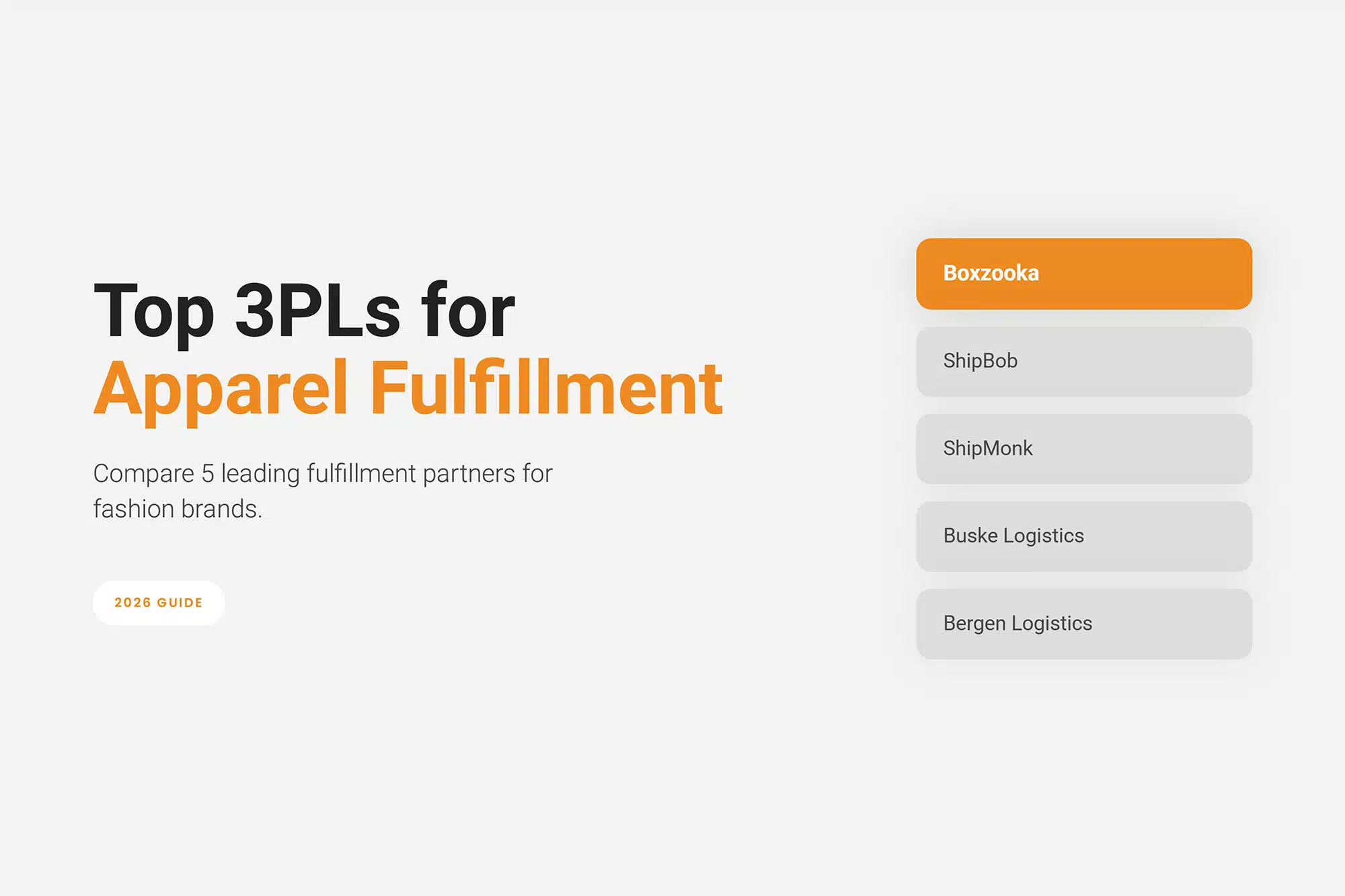
The top 3PLs for apparel fulfillment include Boxzooka, ShipBob, ShipMonk, Buske Logistics, and Bergen Logistics, each built around a different combination of catalog complexity, return volume, and channel mix. The right fit for your growing business depends less on brand size and more on how well a provider handles garment-specific requirements like size and color variants, garment-on-hanger storage, and fast return processing.