Categories
News

Boxzooka Announces Partnership with Tower Arch Capital

Boxzooka has a new strategic partner to help us serve our clients even better. Tower Arch Capital, a growth oriented private equity firm based in Salt Lake City, has partnered with Boxzooka founder Brendan Heegan and the executive team to recapitalize the company. For our clients, this means faster investment in the proprietary technology that powers their operations, an expanding fulfillment network, and continued access to the high touch service they have come to expect from our team.

Tower Arch stood out because they believe in our culture, respect how we operate, and share our commitment to building a company that puts client success first.

Founded in 2014 by Brendan Heegan, Boxzooka has grown into a trusted, software driven fulfillment partner for premium, high growth apparel, beauty, and wellness brands. “As we evaluated potential partners, it was important to us that we found a group that understood what makes Boxzooka different,” said Heegan. “Tower Arch stood out because they believe in our culture, respect how we operate, and share our commitment to building a company that puts client success first.”

As part of the transaction, Nick Pellegrino, Boxzooka’s President & COO, will become CEO, and Brendan Heegan will move into the role of Chairman of the Board, staying closely involved in the company’s long-term strategy. The rest of our leadership team, and the day-to-day service and support clients rely on, remain unchanged. “This partnership allows us to accelerate investments in our proprietary technology, expand our logistics network, and further elevate our client experience,” said Pellegrino. “As we scale, our commitment to delivering flexible, boutique service will remain a defining characteristic of the Boxzooka brand.”

This is an investment in the direction we are already headed, not a change in course, and we are excited at the opportunities ahead for our clients.

Read the full press release for more.

Categories
News

Boxzooka CEO Brendan Heegan’s Report on Overcoming Tariff Disruptions

With reports about the tariffs taking up more and more headlines, LinkedIn posts, and tense conversations in boardrooms, Inbound Logistics asked the team at Boxzooka to share our take on how to prepare in the present and to prosper in the future.

Our founder and CEO, Brendan Heegan, was recently featured in a leading industry article titled “Tariffs Can Drag Down Your Supply Chain, Unless You’re Prepared.” Brendan shared how ecommerce and retail businesses can keep their supply chains intact even with tariff-related disruptions in global logistics. 

As international tariffs continue to shift, Brendan discussed how to build internal resilience in the face of external upheavals. The root of his advice centered on proactive planning, strategic sourcing, and technology-driven solutions. 

How to Optimize Supply Chains 

Diversifying supplier networks, optimizing shipping routes, and partnering with well-established 3PL providers (like Boxzooka) can help mitigate the effects of rising costs, transportation delays, and other impacts from the new tariffs.

Brendan told Inbound Logistics that the key to reducing supply chain costs and increasing customer satisfaction lies in taking a proactive approach to supply chain management – not a reactive one. He stressed that the important role that technology plays (such as Transportation Management Systems and Warehouse Management Systems) in modern logistics cannot be overstated. 

Stay Ahead with Boxzooka

At Boxzooka, we are committed to helping our clients stay ahead of industry challenges through custom fulfillment strategies, advanced technology, and reliable partnerships. For more on how our omni-channel integrations, real-time inventory tracking, and historical dashboard analytics — get a quote here.

Categories
News

Boxzooka Shares Retail Survival Strategies Amid Tariff Uncertainty

With the ongoing pressures businesses feel to get ahead of the looming tariffs, our CEO and founder at Boxzooka, Brendan Heegan, has been sharing industry advice on the de minimis rule with Vogue Business, fashion industry tariffs with Glossy, and now, Retail Customer Experience.

Chief editor Judy Mottl asked him to talk about how the retail industry can mitigate consumers’ reactions to changing company policies in the Retail Customer Experience article, “Tariffs in retail: What retailers should do as consumers react, experts offer advice.”

From sourcing and pricing strategies to shifts in consumer behavior, the ripple effects of trade policy are being felt across every part of the supply chain. The May 6, 2025, Retail Customer Experience reports on the state of the current economy.

The current pause in the US-China trade war has many feeling hopeful, but retailers and shoppers are still hesitant. 70% of U.S. adults expect higher prices due to tariffs, and 43% already report increased prices. As a result, more than 40% of consumers have already changed spending habits, with many citing worries about inflation as a driving factor.

In this interview, Brendan explained that one of the biggest challenges for retailers is the uncertainty surrounding the details, timing, and scale of tariff increases. Brands are reevaluating production plans and exploring new sourcing strategies, especially those currently relying on imports from China. 

How Retailers Can Stay Competitive Amid Rising Tariffs

Boxzooka helps our customers with our tech-driven, data-backed 3PL shipping, warehousing, and logistics, but we’re also there to share the insights we’ve gathered from decades in this industry.

Brendan was asked to provide his perspective on how brands are adjusting — and how Boxzooka is helping them do it. Two examples include bundling with Boxzooka’s kitting services and Boxzooka’s access to lower-cost SKUs. 

Beyond that, some of Boxzooka’s larger clients took action early, bringing in product in late 2024 and early 2025 to stay ahead of possible cost hikes. Smaller brands, however, are being more cautious, especially since consumer demand for non-essential products is dropping off.

How Boxzooka Is Helping Retailers Turn Tariff Trouble Into Opportunity

Boxzooka is an award-winning third-party logistics (3PL) provider helping eCommerce companies adapt to global supply chain changes, remain compliant with regulations, and scale successfully.

Our 3PL services include:

  • eCommerce Fulfillment
  • Pick and Pack
  • Kitting
  • Cross-Border Shipping
  • Custom Technology Integrations
  • and more

With our strategically located fulfillment centers and our proprietary logistics platform, at Boxzooka, we have the tools and flexibility brands need to stay afloat and stay ahead of the competition.

Interested in how our 3PL services can serve you? Let’s talk about how we can help your brand.

Categories
Fulfillment News

What to Know About 3PL Tariffs in Atlanta

For businesses evaluating 3PL companies in Atlanta, the quoting process can be confusing. All quotes look significantly different, fees are often obscured in complex rate sheets, and a direct comparison between providers seems almost impossible. The confusion with 3PL pricing is common, particularly within Atlanta’s highly competitive market.

With this guide, we hope to simplify the process. We’ll show you exactly what drives 3PL costs in Atlanta, explain tariffs simply, and clarify how to read the documents. We’ll also tell you what questions to ask providers so you can compare apples to apples and avoid surprise fees.

Import Tariffs vs. 3PL Tariffs: What’s the Difference?

3PL tariffs are completely different from import tariffs. They are your 3PL provider’s published rate sheet and rules for services like receiving, storage, and pick fees. Import tariffs are taxes on goods that you buy from other countries. You may encounter both if you import inventory and outsource eCommerce fulfillment. Connect the dots to budgeting so you can separate actual logistics service costs from government‑imposed duties when you evaluate providers and negotiate terms.

What Are Import Tariffs?

Import tariffs are taxes governments charge on imported goods. These tariffs change with trade policy and affect your landed cost before your product reaches the warehouse. Georgia set a record $198.7 billion in total trade in 2024, making it the nation’s sixth-largest trading state. 

Because Atlanta brands source globally, understanding how duty changes ripple through your profit and loss statement is key. Monitoring trade policy and building forecasting buffers will help you budget and price more confidently across seasons — especially when macro trends shift. For practical management tips, we recommend leaders follow neutral research on tariff impacts and supply‑chain visibility to keep surprises low.

What Are 3PL Tariffs?

In transportation, a 3PL or carrier tariff is simply a published document of rates, rules, and service terms — you can think of it as your pricing encyclopedia. Unlike import duties, this is a provider‑controlled document you can review, clarify, and negotiate. A clean tariff prevents invoice guesswork, makes “apples‑to‑apples” comparisons possible, and keeps teams aligned on included fees versus à la carte. Below are the standard line items you will typically see.

Typical 3PL tariffs explained simply by categories in Atlanta:

  • Receiving: Per carton, per pallet, or labor hour.
  • Storage: Per pallet position, bin, shelf, or cubic footage, usually monthly.
  • Pick & pack: Base pick per order plus add-on per additional SKU (Stock Keeping Unit).
  • Packaging supplies: Standard materials vs. custom or branded packaging.
  • Labeling/kitting: Reworks, bundles, inserts, ticketing.
  • Returns processing: Inspection, rebagging, restocking, or quarantine.
  • Custom handling: Any non‑standard step that adds time or materials.

Import tariffs and 3PL tariffs might sound connected, but in reality, they are entirely separate. 3PL Tariffs is a transparent breakdown of pricing that comes with taking advantage of a 3PL fulfillment warehouse. You might pay both in some scenarios, but they’re governed and negotiated very differently.

Why Tariffs Vary by Region: The Atlanta Angle

Regional context matters. Atlanta is a Southeastern transport hub — connecting with a central air gateway, interstate nexus, and the beneficiary of Georgia’s port growth. That mix shapes labor supply, carrier capacity, and facility demand, all inputs into 3PL pricing that Atlanta teams see on quotes. Pair that with shifting warehouse vacancy, and you get a meaningful price spread across the metro.

Factors Affecting Pricing 3PL Companies Atlanta

When evaluating fulfillment partners in Atlanta, it helps to understand the local factors that can influence 3PL pricing. These costs are a part of the bigger picture that impacts service levels, delivery speed, and long-term scalability for your brand.

  • Local labor dynamics: Wages and workforce availability play a role in activities like receiving, kitting, and cycle counts. According to recent BLS data, Atlanta’s average hourly wage is above the national average, with transportation and material-handling roles making up a large portion of the region’s employment base.
  • Access to carrier hubs: Atlanta is home to UPS’s global headquarters, and nearby Memphis hosts FedEx’s major hub. These connections shape air capacity, transit times, and service reliability across the Southeast, making carrier proximity an important factor for 3PL pricing.
  • Warehouse supply and demand: Market conditions in Atlanta’s industrial sector show vacancy rates rising slightly while absorption slows. These shifts can influence storage costs and the flexibility of space commitments in 3PL contracts.
  • Port-driven flows: Georgia’s ongoing investment in port infrastructure continues to strengthen regional distribution. This emphasis on growth can create ripple effects in logistics strategies and overall pricing for brands operating in the area.

3PL Pricing in Atlanta: How Tariffs Factor In

It is important to understand that 3PL tariff pricing refers to a provider’s detailed rate sheet, the rules, minimums, and unit prices that govern warehouse work. These factors are specific to 3PL companies in Atlanta and will impact what you’ll see on quotes so ensure that you align on your core cost drivers. Then look at volume tiers, order mix, and seasonal spikes that may change your effective cost per order in Atlanta. Here’s how to decode the numbers and compare 3PL pricing options in Atlanta with confidence and avoid surprise line items.

Typical Components of 3PL Pricing to compare include:

  • Labor market in metro Atlanta: Tight labor and seasonal swings lift hourly rates, which push up receiving, pick/pack, and VAS. In your 3PL tariffs in Atlanta, require productivity assumptions and peak multipliers in writing.
  • Warehouse vacancy: Low vacancy near key submarkets raises storage and can introduce congestion/appointment fees.
  • Proximity to parcel & LTL hubs: Atlanta’s hub density enables later cutoffs and cheaper ground to the Southeast, reducing costly upgrades.
  • Port-driven inbound: Import surges ripple into Atlanta receiving; container unload, drayage pass-throughs, detention/demurrage risk. Get container vs. pallet receiving rates and guaranteed appointment windows.
  • Seasonality across the Southeast: Bake seasonal tiers and caps into your 3PL tariffs in Atlanta before peak in the fourth quarter.
  • Traffic and appointment constraints: Congestion near Atlanta airport/rail yards can trigger appointment and after-hours charges. Codify fee waivers for shipper-caused delays and penalties for missed windows.

To put this into practice, consider a simple workflow. Start by mapping the regional factors above into your cost model, then calculate your effective cost per order at low, average, and peak volumes. Think of the tariff as a living guide that evolves with your business, not just a static rate sheet. 

Normalize every quote against your actual order profile so comparisons stay fair and meaningful. Request a sample invoice to see how fees are applied, clarify which services are included, and outline how accessorials are triggered. This way, your client success manager can help pre-approve exceptions, and you’ll gain clearer visibility into costs. With this approach, comparing Atlanta 3PL options becomes easier—and your warehouse pricing stays more predictable.

Key Pricing Terms to Understand in a Tariff

Glossaries aren’t glamorous, but they save budgets. Knowing how line items are defined helps you compare 3PLs fairly. Below we translate standard pricing terms you’ll find in most rate sheets. Use this to normalize quotes and to build internal models for 3PL warehouse pricing.

Glossaries aren’t glamorous, but they save budgets. Knowing how line items are defined helps you compare 3PLs fairly. Below we translate standard pricing terms you’ll find in most rate sheets. Use this to normalize quotes and to build internal models for 3PL warehouse pricing.

  • Per-pallet vs. per-SKU storage: Pallet pricing favors dense SKUs; per-SKU/bin pricing suits long-tail catalogs. Track average pallet density to predict where your mix lands.
  • Minimum order fees: Fees charged when orders fall below a pick threshold. Clarify how your provider handles holiday and promotion exceptions.
  • Receiving rates: Decide whether a flat rate (often better for predictable, palletized inbound) or an hourly rate (often better for mixed or cartonized inbound) is the right fit for your profile.
  • Standard pick vs. add-on SKUs: The first pick often includes packout; add-ons are incremental. Ask your 3PL how they count kitted bundles.
  • Inventory cycle counts: Routine counts that maintain accuracy without shutting down operations. They’re different from a complete physical and often priced per hour or by location count.
  • Packaging and material markups: Material pass-throughs vs. markups vary. Correct packaging also impacts the LTL freight class and claims risk under NMFC rules — another reason to spec it up front.
  • Accessorial charges: Supplemental charges layered on top of base rates, such as after-hours fees, appointment charges, or detention.
  • Bill of Lading (BOL): The foundational shipment document. For parcel deliveries, the shipping label essentially serves as the contract of carriage, similar to a BOL in freight.

How Should You Choose 3PL Companies in Atlanta for 3PL Tariff Management

Atlanta has many 3PL providers, but their ability to manage tariff complexity can vary widely. Choosing the right Atlanta 3PL for tariff management should lower landed cost, speed Southeast delivery, and make invoices predictable. 

Atlanta’s labor market, warehouse availability, significant parcel and freight hubs, plus access to East Coast ports, all shape 3PL tariffs in Atlanta. If a provider’s network isn’t set up to take advantage of Atlanta’s logistics strengths, the costs can add up in ways that don’t always show on the initial quote.

What to Look for in a Tariff-Savvy 3PL:

  • Customs expertise: Proactive classification, broker coordination, and playbooks that cut delays and fees.
  • Flexible operations: A 3PL with multiple locations or scalable warehouse space can adjust inventory strategies if tariffs spike.
  • Transparent costs: Providers should clearly outline how they handle fees, so you’re never in the dark about expenses.
  • Network fit for ATL: Capacity near key corridors and carrier hubs; overflow options when demand spikes.
  • Data visibility: WMS reporting that maps fees to SKUs, orders, and lanes so you can manage 3PL tariffs in Atlanta by fact, not guesswork.

While evaluating 3PL companies in Atlanta, also consider how effectively they can serve your region. An East Coast fulfillment center can typically deliver to Atlanta in just a couple of days, so a 3PL based outside Georgia can still meet your needs if they have the right network. Define what’s included, document exception approval rules, and put everything in a simple rate workbook. Then schedule quarterly reviews to revisit tiers, seasonal adders, and any Atlanta-specific cost drivers, so your 3PL companies in Atlanta stay aligned with your growth.

What to Ask a 3PL About Their Tariff

Great procurement is about clarity. Your goal is to learn how pricing flexes with your volume, seasonality, and service mix, before you sign. These questions below keep you out of mystery‑invoice territory. They also surface how a partner thinks about transparency — critical in competitive, urban markets like Atlanta, where carrier dynamics move quickly.

Ask these questions directly:

  • Are any charges volume‑adjusted? How do thresholds or growth tiers work?
  • Are there seasonal surcharges? Holiday peak, seasonal spikes, or carrier surcharges?
  • What’s included vs. à la carte? What’s in the standard pick? What’s “project work”?
  • Can we see a sample invoice? Redacted is fine — we’re checking line‑item clarity.
  • How does pricing change with scale? Do we renegotiate at milestones?
  • How are add-ons billed? Who approves exceptions? What’s the dispute process?

Close the loop by pressure‑testing the quote against reality. Ask the 3PL companies in Atlanta to price three of your past weeks and provide a redacted sample invoice. Map inclusions versus support services, list accessorial triggers, and set the approval workflow. Document everything in a simple rate workbook so your team can compare Atlanta providers and negotiate tiers that scale with growth.

Why Understanding Tariffs Helps Brands Scale Smarter

For Atlanta eCommerce brands, grasping the ins and outs of 3PL tariffs isn’t just a finance exercise — it’s a strategic advantage in scaling your business. Knowledge is power: when you know how tariffs will impact your costs, you can make smarter decisions about pricing, sourcing, and inventory strategy. Instead of reacting to unexpected fees, you can proactively plan for them in advance.

Brands that bake tariff considerations into their growth plans tend to be more resilient. This stability makes it easier to scale operations, enter new markets, and invest confidently in expansion. That’s why savvy companies employ various retail survival strategies for tariff uncertainty — from diversifying suppliers to seeking duty exemptions – to stay agile and efficient despite trade fluctuations.

Ultimately, understanding tariffs – and working with a 3PL partner who does too – helps you scale smarter. Boxzooka collaborates with its clients to forecast and mitigate the impact of tariffs, so there are fewer surprises as you grow. With the proper preparation, Atlanta brands can expand their customer base and supply chain globally without letting tariffs derail their momentum.

Boxzooka’s Transparent Pricing Approach

Clarity beats cleverness. Our teams publish straightforward rate sheets, explain inclusions and triggers, and provide onboarding guidance so there’s no mystery in month one or month twelve. Because your product and order mix evolve, we revisit assumptions as volume and channel mix change — no surprise thresholds, just deliberate recalibration.

How we partner:

  • Tariff‑ready onboarding: We map your landed‑cost model and align invoicing to your needs.
  • Tailored pricing: Built for catalog shape, order profile, and growth goals.
  • National coverage: Our U.S. fulfillment network (including Pennsylvania and Las Vegas) efficiently serves Atlanta with reliable transit options across the Southeast.
  • Data visibility: Proprietary WMS dashboards make inventory management and SLA tracking simple.

Navigating Tariffs with the Right Partner

Tariffs don’t have to hold back your eCommerce growth. When you normalize quotes to your real order profile, pressure-test pricing against an actual week, and document accessorials up front, 3PL tariffs in Atlanta become transparent and predictable. That clarity gives you confidence to budget, scale, and choose partners on true value.

The right logistics partner can turn tariff challenges into growth opportunities. Boxzooka works with you to understand Atlanta’s unique ecosystem, align costs to your catalog and order mix, and build a fulfillment plan that keeps pricing predictable through every season.

Ready to scale without the tariff stress? Contact Boxzooka today for 3PL pricing solutions tailored to your brand. Let’s turn tariff complexity into a launchpad for smarter growth.


 

Categories
News

Brendan Heegan Analyzes De Minimis Rule Shifts in Vogue Business

Boxzooka is proud to announce that our founder and CEO, Brendan Heegan, was recently featured in the Vogue Business article “De minimis disrupted: The fallout for fashion” by Jessica Binns, published on February 10, 2025. Brendan was asked to discuss how possible changes to the de minimis rule could affect the fashion industry.

The de minimis rule previously allowed low-value individual parcels to enter the US duty-free. The threshold was, most recently, $800; anything less than this sum was not subject to customs duties or taxes. (When set originally in 1938, the threshold was $1 or $5, depending on the object’s use.) 

Single packages, namely apparel from fast fashion companies based in China, are some of the biggest points of conversation around this topic. In 2023, more than one billion shipments (with a value of $54.5 billion) avoided taxes under the de minimis rule.

On February 1, 2025, President Trump signed an executive order that added a 10% tariff on Chinese imports. He later rescinded this on February 5, pending an appraisal from the Secretary of Commerce. 

With the potential ramifications of the fashion industry, both domestic and international, in question, Vogue Business reached out to industry experts, including Brendan Heegan. Brendan was asked to share his insight into how businesses, especially smaller fashion brands, are adjusting to these possible changes to trade regulations.

Brendan Heegan’s Report to Vogue Business

In the Vogue Business article, Heegan explained how Boxzooka’s smaller fashion clients are already considering alternative sourcing strategies.

Some are exploring domestic manufacturing options, while larger brands are expanding their supply chains into Southeast Asia and India to mitigate the effects of tariffs.

Brendan also discussed how Boxzooka is helping its clients reevaluate their logistics strategies to keep thriving in a post-de minimis industry. Heegan reported that global brands are seeing the shift as an “opportunity” instead of “a setback.” 

International brands are analyzing “bulk imports of finished goods into US fulfilment centres” rather than the current direct-to-consumer (DTC) model. Brendan said this could minimize the effect of increased duties and reduce bottlenecks in distribution processes.

About Boxzooka

As an award-winning third-party logistics provider (3PL), Boxzooka helps eCommerce companies comply with regulatory changes, stay ahead of industry shifts, and grow their businesses. 

Boxzooka’s technology-driven, fast, reliable 3PL services include eCommerce fulfillment, 3PL Pick and Pack, 3PL Kitting Services, and more. Our proprietary technology, carefully-chosen locations, and platform integrations help brands scale quickly and sustainably with smooth logistics operations. 
For more information on how Boxzooka can help your business adapt to the evolving supply chain and trade landscape, send us a note here.

Categories
News

Boxzooka CEO Brendan Heegan Weighs In on Fashion’s Strategy for Tariff Impact in Glossy

After our contribution to Vogue Business last month, Boxzooka was interviewed by Glossy for its piece on the effects of recent tariffs. The article explores how the fashion industry is adjusting to the challenges posed by increased tariffs and how businesses are attempting to stay ahead of rising costs and shifting trade policies.

Our founder and CEO, Brendan Heegan, was quoted in Glossy’s March 6, 2025 article “Fashion Briefing: Is There Anything Fashion Can Do to Alleviate Tariff Impact?” Along with other industry leaders, including Meghan Frank, CFO of Lululemon, and Melanie DiSalvo, founder of supply chain consultancy Virtue + Vice, Brendan spoke to how the tariffs were affecting the fashion industry.


Boxzooka CEO Brendan Heegan advice on supply chain management tips


Increasing Profits When Tariffs Increase

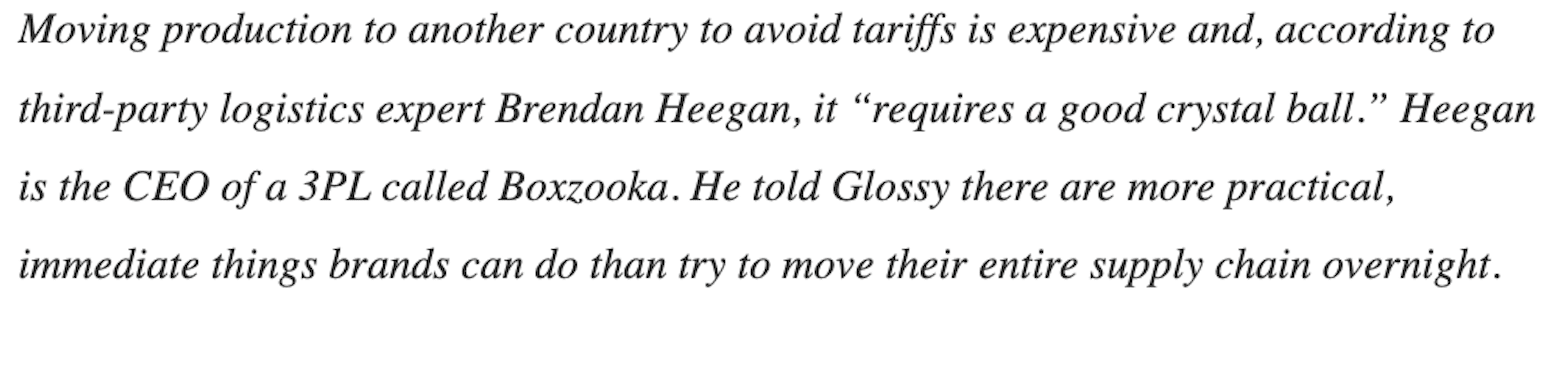
Brendan was asked for his take on how companies can handle the logistics of supply chain disruptions. He told Glossy that moving production to another country to avoid tariffs can be costly and unpredictable. However, storing items overseas, paying for what is shipped only, is more feasible.

Along with that, Brendan recommended business owners might want to consider:

  • Focusing on core competencies and top-selling items
  • Limiting the range of stock keeping units (SKUs)
  • Discussing increased volume orders for discounted rates
  • Or possibly — passing the increased costs on to the consumer


Brendan discussed how Boxzooka’s clients are weathering the storm, including diversifying their sourcing models and rethinking their fulfillment operations. Companies are looking to rely more on domestic manufacturing and shifting their supply chains to soften the impact of the new tariffs.

Brendan stressed that the current manufacturing environment — while challenging — presents an incredible opportunity for companies to reevaluate their supply chains and create more resilient, cost-effective models for the future.

Boxzooka’s Approach

Technology-driven logistics solutions, like our 3PL Transportation Management System, at Boxzooka, are helping clients adapt faster and more effectively to these changes, minimizing disruptions and maximizing growth.

For more on how Boxzooka helps eCommerce brands overcome roadblocks, like these new tariffs, and ride the changing global trade tides, reach out to us here.


Categories
News

Boxzooka CEO Explains the New Tariffs’ Impact

The tariffs — what will happen next and what to do about them — are at the top of everyone’s minds. As a leading third-party logistics (3PL) provider, we consider it an honor and our duty to give business owners the information they need to stay afloat and exceed both their own projections and those of their competitors.

Brendan Heegan, Boxzooka founder and CEO, was recently featured in Specialty Retailer’s April 23, 2025 article, “The Impact of Tariffs on Retailers.” Specialty Retailer author Krystina Skibo asked Brendan about the effects of newly enacted tariffs under President Trump and how retailers are absorbing or offsetting the financial strain.


Specialty Retailer logo


Boxzooka Weighs In: How Will Tariffs Impact Businesses?

With the introduction of a 10% universal tariff and additional reciprocal tariffs across more than 60 countries, many U.S. retailers are now facing difficult decisions.

More companies are looking to change manufacturing locations. Others are attempting to build up financial cushions by accelerating sales before prices rise or reevaluating their supply chain strategy and fulfillment operations.

eCommerce sellers are asking us if they should raise prices, shrink profit margins, or try to rapidly pivot their supply chains. Or is there another strategy altogether?

Brendan Heegan explained to Specialty Retailer that while retailers may want to adjust manufacturing origins to bypass tariffs, the logistics of doing so are complex and time-consuming. He told the magazine that pivoting at the drop of a hat isn’t an easy — or cost-effective — solution.

In light of that, Brendan said to look at the other options, especially if the tariffs might get reversed…

How eCommerce Brands Can Adapt to New Tariffs with Boxzooka

At Boxzooka, we’re working directly with our clients to help them stay true to their course (and ROI projections) with logistics flexibility, smarter inventory management, and data-driven sourcing strategies.

For companies that cannot switch suppliers quickly, Boxzooka’s fulfillment network and technology-driven 3PL services help brands remain agile and responsive. With staggered import planning to strategic warehousing and SKU rationalization, it’s possible to expand your business while other companies simply try to weather the storm. 

Boxzooka: Leading Voice in Times of Economic Volatility 

Boxzooka is honored to be trusted by global eCommerce brands to deliver stress-free, scalable, and cost-effective logistics solutions.

Our proprietary tech platform and customizable service model make it easy for brands to track their inventory, orders, and returns in real time. No matter how turbulent trade and regulatory conditions become, you can rely on cold, hard numbers to give you a picture (complete with critical analytics) of how your business is doing and what could be done better. 

Need Custom Strategies to Tackle Tariff Increases?

For more on how the Boxzooka team is helping retailers grow even when tariffs and global trade policy are changing rapidly — and how our fulfillment and inventory management could work for you — let’s set up a time to talk.


Categories
News

Boxzooka Awarded Best in Business by Inc. Magazine

We’re thrilled to announce that Inc. Magazine included Boxzooka on their 2024 Best in Business list as a leading company in the Logistics & Transportation Industry. 

This award, in the “E-commerce, Prosperous and Thriving” category, is a testament to the last 10+ years of pursuing our goal—revolutionizing 3PL services. We’re also proud that Inc. named our third-party logistics fulfillment distribution center and warehouse management program in their announcement. 

At Boxzooka, we know our growth means we’re helping eCommerce companies grow, and that’s our primary goal. 

What Inc.’s Award Means for Boxzooka

Being included in Inc.’s Best in Business list is not just about winning an award—it’s a reflection of the progress we’ve made and the impact we’ve had on our clients. To earn our spot on the Best in Business list, we had to show more than just revenue growth. We had to submit proof of how our 3PL services brought positive change to our community and our industry. 

Inc.’s Best in Business methodology stresses positive client relationships, including engaging with our community. At Boxzooka, we’ve always focused on solving real-world problems for eCommerce brands, simplifying complex logistics, and prioritizing the customer experience. Inc.’s data-driven evaluation saw that Boxzooka’s customers are happy and how we contribute to innovation on a large scale. 

What Makes Boxzooka Different From Other 3PL Services

Brendan Heegan, CEO and Boxzooka Founder, spoke about our company’s mission recently. In a recent interview about how Inc. Magazine included Boxzooka on their 2024 Best in Business List, Brendan talked about what Inc.’s editors saw in our 3PL services. 

Brendan mentioned that our Warehouse Management Software (WMS) and Transportation Management Software (TMS) put Boxzooka in a unique position. Boxzooka provides superior eCommerce fulfillment services and customer service all at a fraction of the cost. It’s not only businesses near our central hubs—all eCommerce companies, regardless of location, can rely on us. 

Our proprietary technology is only part of the equation recognized by Inc. Magazine. The other part is our industry expertise in 3PL logistics and fulfillment services. When eCommerce companies work with Boxzooka, our pick and pack services are only the beginning. 

We also advise clients on smarter shipping solutions, including how to better manage inventory levels and reduce expenses. At the end of the day, when we talk about how to ship, we’re really talking about how to scale. Helping our clients stand out, survive, and surpass competitors in the increasingly competitive eCommerce world is one of our proudest accomplishments. 

The Award-Winning Boxzooka Team

Being part of Inc.’s Best in Business list is only possible when an organization has all hands on deck. We want to emphasize that this achievement wouldn’t be possible without the incredible Boxzooka team. From the engineers who develop our technology to the third-party logistics experts who keep everything running smoothly, every single person at Boxzooka plays a crucial role in making our vision—and our eCommerce clients’ visions—a reality. 

Our people are the heart of Boxzooka. Their expertise, creativity, and passion drive us forward so that we can continue to push the envelope on what’s possible.

What’s Next for Boxzooka

As our in-house team of engineers continues working away, so do our logistics experts and customer experience professionals. Boxzooka is committed to continuously innovating and improving our fulfillment technology, expanding our service offerings, and helping even more eCommerce businesses scale and thrive in a fast-evolving market. We’re proud that our customers call us the number-one 3PL provider. 

So, what’s next? Along with Inc.’s award, we’re equally pleased to announce we’re expanding our services, including expanding our warehouse capacity. We’re also bringing in new team members and talented individuals. To secure a place on Inc.’s prestigious list, we had to prove we spent 2024 innovating and outperforming our industry competitors. After ten years of this dedication, we have no intention of stopping now. 

Better Your Business With Boxzooka

As we keep moving upward and expanding outward, our clients will too. Our 3PL services make it possible for eCommerce companies to see their orders filled quickly and accurately so they can see their dreams come true. 

To find out more about what we do or get a quote, contact us here and experience how we’re revolutionizing eCommerce and fulfillment services for yourself!

Categories
News

Optimizing eCommerce with Multi-Carrier Shipping Logistics

Margherita Bruno, Editor, Port Technology International, Interviewing Brendan Heegan, Founder and CEO, Boxzooka

In today’s dynamic landscape of maritime logistics and shipping, the role of multi-carrier delivery options extends far beyond merely enhancing customer satisfaction. This interview delves into how these strategies are revolutionizing the way online retailers manage their supply chains, ensuring not only the efficient movement of goods but also significant cost savings and operational agility.

In the context of maritime logistics and shipping, how do you see multi-carrier delivery options benefitting online retailers beyond just customer satisfaction?   

BH: Transportation logistics and expenses are a major portion of online retailers’ budgets and, therefore, require resources and intelligent planning. We have all witnessed the disruptions in the global supply chain and retailers have to balance those challenges with satisfying customers. Obviously, having multi-carrier delivery options is important for retailers and finding the right partners at each stage of the supply chain is essential. Retailers have a long list of necessary action items to mitigate their supply chain challenges, including:

  • Planning ahead and forecasting product demand accurately.
  • Diversifying suppliers to avoid single points of failure.
  • Leveraging technologies for visibility, demand planning, routing and sourcing.
  • Building contingency plans.
  • Monitoring and communicating in real-time.

“HAVING MULTI-CARRIER DELIVERY OPTIONS IS IMPORTANT FOR RETAILERS AND FINDING THE RIGHT PARTNERS AT EACH STAGE OF THE SUPPLY CHAIN IS ESSENTIAL”

Illustration of a global logistics network with transportation icons over a world map

From your experience, how can the integration of diverse carrier networks streamline operations for e-commerce businesses, especially when dealing with global shipping and port logistics?

BH: Many, if not most, online retailers are sourcing products from overseas and the inbound merchandise is destined to become the revenue that drives everything in the business. Transportation Management Systems effectively match the best carrier with the route and method needed to deliver the goods. There are numerous options available to help streamline operations from origin to destination and here are a few to consider:

  • Smaller production runs can help reduce transit time and expense.
  • Less than Container Load, LCL, creates more options for transport
  • Some shippers provide storage options at origin at a lower cost to help schedule shipments.
  • Streamlining receiving operations with proper labelling, cartonisation, and palletization.

Retailers need to pick good partners with the experience and creativity to customize solutions for their business and supply chain dynamics.

“TRADE ROUTE DISRUPTIONS AROUND THE GLOBE IN RECENT MONTHS HAVE SERVED AS AN IMPORTANT REMINDER IN THE WORLD OF LOGISTICS OF THE IMPORTANCE OF BEING READY FOR ANYTHING.”

Aerial view of cargo ships and shipping containers at a port, titled The Future of Shipping

Could you elaborate on specific challenges online retailers face with limited delivery options, especially in terms of port terminal access and shipping routes?

BH: Retailers face numerous challenges today with the choices for bringing products into America from overseas. We have all witnessed a surge in pricing levels based on capacity issues from Asia to the US along with the disruption in some of the trade routes. The Panama Canal is low on water this year, limiting the throughput and forcing some shipping lines to take the long way around South America to the east coast. This condition has also limited the size of the container ships that can safely pass through the canal.

The geopolitical turbulence in the Middle East has been disruptive to container ship transit in the Suez Canal and the Persian Gulf. The shipping routes around the Cape of Good Hope in South Africa are adding time and expense to every container. Planning even further ahead has become the norm for retailers to avoid these supply chain delays. Unfortunately, the additional costs end up being passed on to the end customer.

Trade route disruptions around the globe in recent months have served as an important reminder in the world of logistics of the importance of being ready for anything.

Boxzooka WMS dashboard shown across desktop, laptop, tablet, and phone

In maritime regions with varying infrastructure capabilities, how do multi-carrier strategies ensure reliable and timely delivery, thus optimising supply chain efficiency for online retailers?

BH: The Key Bridge damage in Baltimore is a dramatic example of an “infrastructure challenge” that led to disruption in that port. Naturally, the volume of inbound container ships had to be re-routed and delays occurred. Baltimore has a significant amount of RoRo volume with automobiles and some of that volume was transferred to Newark incurring additional costs and rerouting to land-based deliveries.

Brands and retailers that have experienced such issues develop contingency plans that weigh the options and alternative transit modes to keep their products moving. Multiple carrier choices might include an “accelerated” ship method on a smaller, faster container ship which costs more and delivers faster. Airfreight can be an expensive option but may become viable with the right product mix.

Having good partners with great technology is important for strategy development and decision making. It helps to pick carriers and ports that have the capacity and capabilities to manage the entire process including the customs brokerage and delivery via domestic carriers.

“PROVIDING RETAILERS WITH DASHBOARDS AND REAL-TIME INFORMATION IMPROVES DECISIONMAKING AND PROVIDES VISIBILITY ACROSS THE SUPPLY CHAIN.”

Considering the intersection of port operations and multicarrier delivery, what are some innovative approaches or technologies that are enhancing shipment visibility and delivery predictability for e-commerce companies?

BH: Technology Driven Fulfilment is our tagline and a core methodology for fulfilment and transportation services. We build systems that easily integrate with multiple carriers and transportation service providers. Retailers cannot afford to lose visibility of their products on the journey from production facilities to carriers to ports and to fulfilment providers.

Leveraging technology such as Warehouse Management Systems (WMS) and Transportation Management Systems (TMS) to enhance inventory management, visibility, traceability and efficiency in the supply chain. These systems can provide early warnings that can prompt proactive resolutions.

Providing retailers with dashboards and real-time information improves decision making and provides visibility across the supply chain. Getting quotes quickly and booking carriers in seconds helps get products moving. Those technology tools build out business analytics and help develop insights for future planning.

Categories
News

Shipping Container Cost Up 210% Since December

The availability of ocean carrier cargo containers in June 2024, coupled with the rising shipping container cost, rivals the worst days of Covid-19 and the supply chain snarls that came along with the pandemic.

While those days are long gone, new chokepoints are creating an unsettling sense of deja vu as container rates spike yet again. This is not a new trend, but one that has been building since late 2023, when shipping container costs for a 40ft container hovered around a more stable $1,500.00. That number has continually grown since, hitting $2,700.00 in late April, then a major jump up to $4,200.00 in late May, and again up to $4,700.00 in early June.

With fewer containers available as peak season freight shipping gets underway, the logistics world is yet again faced with the unenviable task of navigating these complicated supply chains while managing the rising costs. Shipping container cost is becoming a critical factor for businesses to consider.

The Container Conundrum

It doesn’t take much to cause problems. Think about this. Still today, about 90% of global commerce is carried out on the high seas. Meaning that the overwhelming majority of goods must journey on ocean carriers before reaching the final destination.

The situation that has led to these increased costs really started about a year ago as low water levels made navigation in the Panama Canal difficult, pushing many carriers to choose alternate routes, including around South America’s Cape Horn. From here the dominos have continued to fall, as terror attacks on the Red Sea have grown throughout 2024 diverting many carriers around the tip of Africa. Then the collapse of the Key Bridge in Baltimore shuttered one of the world’s busiest ports. Now severe weather in Asia and labor issues at various ports are exasperating an already tough situation.

These issues have forced longer voyages and in order to keep on schedule, many vessels have opted to save time at port by not loading up with empty containers. All of this is happening as preparations for peak season, including shipping of back to school and holiday goods to their destinations, is kicking into high gear. Consequently, businesses are more frequently asking about the current shipping container cost to plan their logistics.

drewry-world-container-showcasing-shipping-container-cost-over-time

Perfect Storm of Bad Timing

There is growing concern that peak season deliveries could be affected. Meaning, retail and ecommerce demand planners could be in for growing headaches as we head further into the summer months, and get closer to the most important time of the year for retail sales.

And, it means that the higher rates for ocean freight climb, the harder it will be to insulate consumers from the increased expense. As a result, understanding the shipping container cost becomes even more crucial for budget management.

If this situation continues to get worse, the most immediate impact could be seen in back to school inventory as parents begin preparing their kids for the new school year as soon as July. Right on the heels of back to school is the holiday season and if these issues in the supply chain persist, we could be in for a rough road to the core of peak season. Planning and ordering for peak should be complete at this point and manufacturers will soon be queuing up orders to hand off to freight carriers, when demand will be even higher for those containers.

The good news is that we have a window to act and do everything possible to stay ahead of this unfolding situation. Assessing the shipping container cost regularly can help businesses stay prepared.

Be Prepared and Plan for Anything

We have learned some valuable lessons over the last four years and it’s important that any retailer be considering strong solutions that can help mitigate these issues, which will likely grow as consumer demand grows.

Visibility & Communication

Being in the know, understanding the situation and knowing how it may impact operations and product availability is key. Follow disruptions and understand their residual impact and if you can’t figure it out, reach out to your suppliers and ask questions. The more quickly action here is taken the more effectively disruptions can be worked around.

Reimagine Warehouse Operations

Consider moving away from major distribution sites in metropolitan cities to several large hubs, served by strategically located distribution centers. Having several major hubs within a two- to three-day delivery time of 95% of American households is the model that is cost-effective and service-oriented. This allows retailers to make up for lost time once delayed ships make it to port and product finally starts closing in on its final destination.

Find a Strong Partner

A third-party logistics (3PL) provider like Boxzooka can be a strong solution for those with the resources. A true 3PL partner offers turnkey solutions and advice around warehousing, inventory efficiencies, SKU depth and velocity, purchase planning and other vital operations. Hire a 3PL with its finger on the pulse of the entire supply chain. They can also provide insights into current shipping container cost trends.

Technology is Your Friend

Technology is evolving all the time and adapting to the latest warehouse management systems (WMS) technology is paramount. The upgrades can be daunting and pricey but that shouldn’t deter any company working within the supply chain. A worthwhile WMS must help you grow your business and keep issues within your supply chain visible at all times.

With the process that leads up to peak season well underway, it’s important that retailers be in the know when it comes to these issues. Understanding the impact that will unfold in the months ahead arms planners with the information they need to proactively and strategically maneuver around these problems, so in the end the consumer isn’t any the wiser to the difficulty in meeting their demand.

At the same time, being in a position to react in a proactive way will help minimize the costs passed along to the end customer, a win-win for everyone!