

What is a 3PL? What eCommerce Brands Need to Know Before They Outsource Fulfillment

Share:
-

-

If your team is spending more time packing boxes than building your brand, it is likely time to take a serious look at third-party logistics. The term “3PL” gets used constantly in eCommerce circles, but what it actually means, and what a good 3PL relationship looks like in practice, is worth unpacking carefully. Here is what you need to know before you make that decision.
Key Takeaways
- A 3PL, or third-party logistics provider, manages warehousing, order fulfillment, shipping, and returns on behalf of eCommerce brands.
- A full-service 3PL can support receiving, inventory storage, pick and pack, carrier management, returns processing, and value-added services such as kitting, bundling, personalization, and subscription box assembly.
- For many growing brands, outsourcing fulfillment can convert fixed warehouse, labor, and technology costs into a more variable operating model.
- Warehouse location and network design are major factors in 3PL selection. The right footprint can reduce shipping zones, improve delivery speed, and lower transportation costs.
- Key criteria for evaluating a 3PL include industry fit, technology, eCommerce integrations, demonstrated operational performance, pricing transparency, communication, and the ability to scale during peak season.
A 3PL Manages the Operational Work Between You and Your Customer
3PL stands for third-party logistics. When you work with a 3PL, you ship your inventory to their warehouse. From there, they handle everything downstream: receiving and storing your products, picking and packing individual orders, and shipping them directly to your customers.
Consider this. Every order your business ships requires warehouse space, trained staff, packaging materials, carrier accounts, and software to track it all. A 3PL handles all of these logistics for you, operating as an extension of your business.
You retain full visibility into your inventory and order status. The 3PL absorbs the infrastructure, the labor, and the carrier relationships. You focus on your product and your customers.
The Services a Full-Service 3PL Actually Provides
Not every provider offers the same scope of services, so it is worth knowing what to ask for. A full-service 3PL typically handles everything from inbound to outbound logistics:
- Receiving and putaway: When your inventory arrives, the warehouse team unloads it, inspects it for accuracy and damage, and assigns it a storage location tracked in a warehouse management system (WMS). You can see exactly how many units you have and where they are at any time.
- Pick and pack: When an order comes in through your eCommerce platform or marketplace, warehouse staff pull the correct items, package them according to your specifications, and prepare them for shipment. For brands that care about the unboxing experience, this step is where your 3PL either earns your trust or loses it.
- Carrier management and shipping: The 3PL generates shipping labels, coordinates with carriers like UPS, FedEx, and USPS, and applies negotiated rates that benefit from their shipping volume. Because 3PLs aggregate shipping volume across multiple clients, they may be able to provide access to competitive carrier rates and a broader mix of shipping options than many brands can secure on their own.
- Returns processing: Reverse logistics are handled on your behalf. A strong reverse-logistics process helps brands recover value by quickly inspecting returned products, determining disposition, refurbishing or repackaging when appropriate, and returning sellable inventory back to stock.
- Kitting and assembly: Subscription boxes, product bundles, gift sets, promotional inserts, and custom assembly work can all be managed at scale. For brands running monthly subscription programs or seasonal gift campaigns, this is a meaningful differentiator.
The Economics Make More Sense Than Most Brands Expect
When you fulfill orders in-house, your costs are largely fixed. You pay for warehouse space, staff, and systems whether you ship 200 orders a month or 2,000. You carry those costs through slow months and then scramble to find additional capacity when volume spikes during peak season.
A 3PL converts most of those fixed costs into variable ones. You pay for the storage space you actually use, the orders that ship, and the labor involved in processing them. When volume is lower, your costs drop. When it spikes, the 3PL absorbs it without you having to hire seasonal staff or find temporary warehouse space on short notice.
For most eCommerce brands, the crossover point where a 3PL becomes more cost-effective than in-house fulfillment comes earlier than expected. Once you factor in the true cost of your own time, the overhead of a warehouse lease, the loaded cost of labor, and the carrying cost of inefficient inventory placement, a 3PL often wins on unit economics well before you hit high order volumes. For many brands, outsourcing starts to make economic sense once monthly order volume becomes consistent enough to justify a more formal fulfillment operation. Some brands begin evaluating 3PLs around a few hundred orders per month, but the right timing depends on order complexity, SKU count, storage needs, shipping profile, and internal labor constraints.
The real comparison is not just 3PL fees versus internal labor. Brands should compare the fully loaded cost of in-house fulfillment, including warehouse rent, labor, payroll burden, packaging, systems, equipment, management time, error costs, returns handling, and shipping.
The Signals That Tell You It Is Time to Make the Switch
There is no single right moment to bring in a 3PL partner. But a few signals tend to come up consistently:
- You are shipping to customers across the country from a single location, and long transit times are hurting your customer satisfaction scores or conversion rate.
- Your team is hitting capacity limits and peak seasons are creating genuine operational strain.
- The cost of managing fulfillment in-house is climbing faster than your order volume.
- You are launching on a new channel, such as Amazon, a retail wholesale program, or a subscription model, and your current setup cannot support it cleanly.
- You want to expand internationally and need a partner with cross-border shipping experience.
Any one of these is a reasonable trigger. The combination of two or more usually means the window to act is now.
Location, Technology, and Communication Are What Separate Good 3PLs from Great Ones
A 3PL’s warehouse location directly affects your customers’ experience. The right 3PL footprint depends on your customer base, order profile, and inventory strategy. Some brands benefit from one strategically located facility near major parcel hubs. Others benefit from a distributed network that places inventory closer to customers and reduces average shipping zones.
Technology is equally important, and it is where many 3PLs fall short. Strong 3PLs maintain a strong WMS and client portal that provide visibility into:
- Real-time inventory by SKU and location
- Order status
- Shipment tracking
- Receiving status
- Returns status
- Inventory adjustments
- Reporting by channel, SKU, order type, and exception
Your fulfillment partner should also integrate directly with your eCommerce platform, whether that is Shopify, BigCommerce, WooCommerce, Magento, or a marketplace like Amazon. Orders should flow automatically from your storefront to the warehouse floor. Technology development should be speedy and responsive to your pain points and needs.
Proactive communication and transparency are not optional features. They are the foundation of a working partnership. Ask any prospective 3PL how they handle exceptions, what their order accuracy rate is, and how they communicate when something goes wrong. The answers will tell you a great deal about whether the relationship will hold up at scale.
What Else to Evaluate Before You Commit
Beyond location and technology, a few other factors are worth weighing:
- Industry fit: A 3PL that specializes in bulky industrial goods is not the right partner for a fashion or beauty brand. Look for a provider with demonstrated experience handling your product category, including any relevant compliance or handling requirements.
- Scalability: Ask how the 3PL handles peak-season volume increases and what their capacity headroom looks like. A provider that is already operating near capacity is a risk. A partner that is equipped to scale with you is key.
- Pricing transparency: Ask for a full rate card upfront, including storage fees, per-order fees, receiving fees, return processing fees, and any minimums. Hidden fees are one of the most common sources of frustration in 3PL relationships.
- References: A reputable 3PL should be willing to connect you with current clients in a similar product category. A conversation with a brand that has worked with a provider for two or three years will tell you more than any sales presentation.
- Client success and communication: Ask who will manage your account, how often you will review performance, how exceptions are escalated, and whether the support team is close enough to the operation to solve issues quickly.
Questions to Ask a 3PL
A strong 3PL eCommerce fulfillment partner should be ready and able to answer these questions:
- Can you show us your WMS and client portal?
- What performance metrics do you track and share with clients?
- What are your order accuracy and on-time shipping rates?
- How do you prepare for peak season?
- What fees are not included in standard pick, pack, storage, and receiving charges?
- How do you handle returns inspection, disposition, and restocking?
- Who manages our account, and how are exceptions escalated?
- What product categories do you specialize in?
- Can you provide references from brands with similar order profiles or SKU complexity?
We Built Boxzooka Around the Brands That Need This Most
At Boxzooka, we work with growth-stage fashion, beauty, and lifestyle brands that need more than a generic fulfillment house. Our fulfillment centers span coast to coast, so we can position your inventory closer to your customers and shrink the average shipping zone across your order base. For most of our clients, that translates directly into lower shipping costs and faster delivery times.
Our technology-enabled platform integrates seamlessly with Shopify, BigCommerce, WooCommerce, Magento, and other major platforms, so orders flow from your storefront to our warehouse floor automatically. Through our Client Experience Portal (CXP), you get real-time visibility into every unit in storage and every order in process, plus the reporting you need to make decisions with confidence.
As a boutique, high-touch 3PL, we handle the full range of eCommerce fulfillment: kitting and assembly, subscription box programs, branded and custom packaging, personalization, returns management, and cross-border shipping. We are also built for complexity, whether that means deep SKU profiles, wholesale and retail orders running alongside your DTC channel, or specialized handling for premium products. Because we built our operation around eCommerce from day one, our team understands what it takes to protect your brand at every touchpoint.
What sets us apart is simple: we shape our operation around your business, not the other way around. Many providers force brands into a one-size-fits-all model, and we do the opposite, building flexible workflows that fit how you actually sell. Our goal is to be the best, not the biggest, so we are selective about the clients we take on and genuinely invested in helping each one scale and thrive. When our clients grow, we grow, and that alignment drives everything we do.
Let’s Talk About Your Operation
Whether you are actively evaluating 3PL partners or just beginning to assess whether outsourcing makes sense, Boxzooka can help you understand your current fulfillment model, identify cost and service opportunities, and determine what the right next step looks like. Contact us today and let’s get started.
Share:

Related Posts

Top 3PLs in Las Vegas for 2026: 10 Fulfillment Partners Compared
The top 3PLs in the Las Vegas area for 2026 include Boxzooka, ShipMonk, ShipBob, ShipNetwork, Saddle Creek Logistics Services, Buske Logistics, AP Express Logistics, Speed Commerce, TCB Global, and Black Mountain Fulfillment. Each runs a facility in Las Vegas, Henderson, or North Las Vegas, but they serve very different brands, so the right pick depends on your volume, channels, and products.

Amazon FBA vs. 3PL: Which Fulfillment Model Is Right for Your Brand?
FBA and a 3PL aren’t strictly either/or. A lot of brands use FBA to keep their fastest-moving Amazon SKUs Prime eligible, while a 3PL handles everything FBA was never built for: DTC orders, wholesale accounts, other marketplaces, overflow inventory, and even the replenishment shipments that feed FBA itself. The real question isn’t whether FBA works. It’s whether FBA alone is still the most efficient way to fulfill your whole catalog.

Las Vegas: Boxzooka’s West Coast Fulfillment Center
The instinct is to assume West Coast fulfillment means a warehouse physically in California. In practice, the better question is transit time, not city limits. A facility that reaches the major West Coast population centers within one to two days by ground delivers nearly the same customer experience as a warehouse sitting inside any one of those cities, while giving a 3PL more room to build and scale the facility behind it.
Top 3PLs for Apparel Fulfillment in 2026: How to Choose the Right Partner
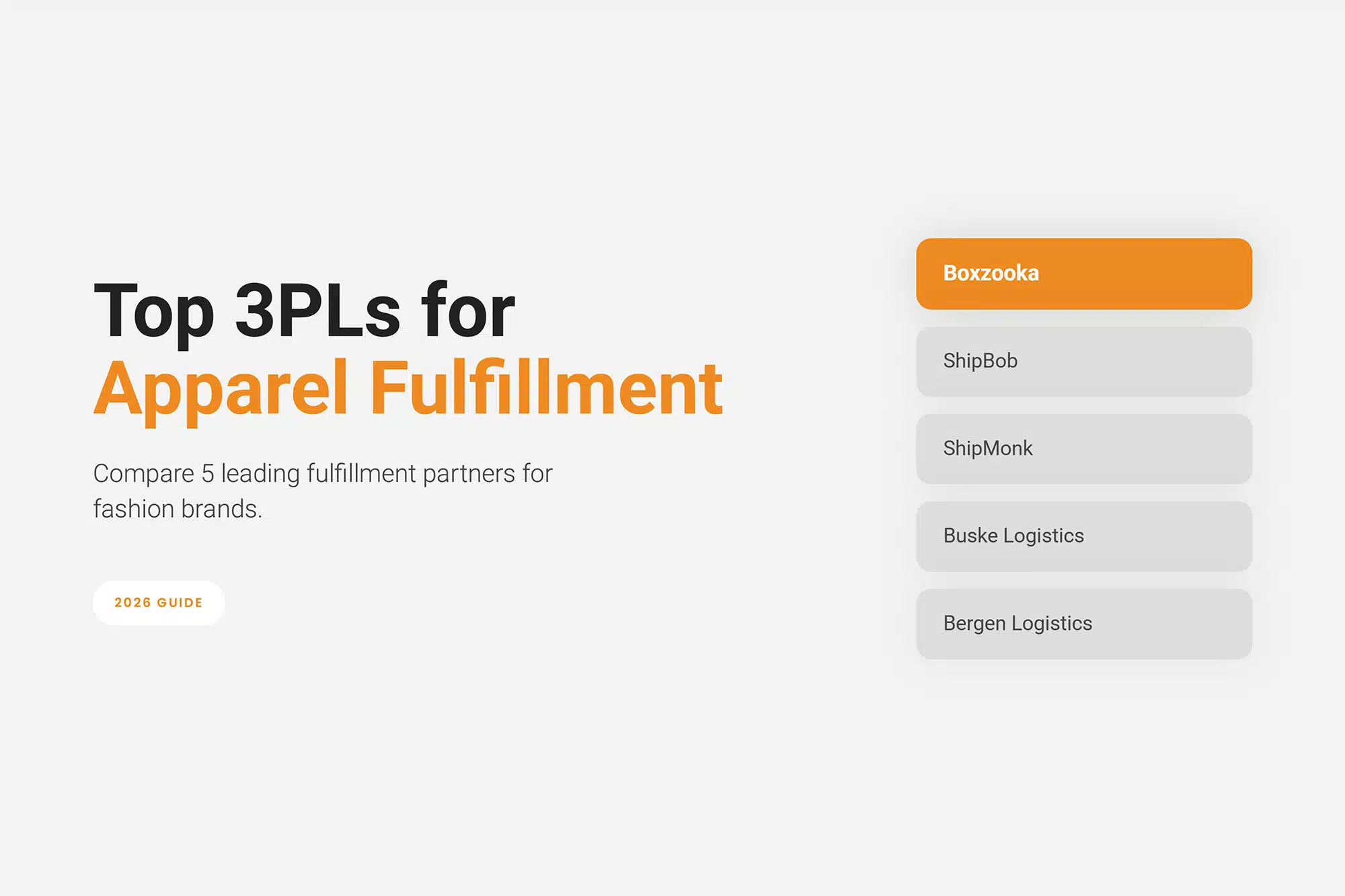
The top 3PLs for apparel fulfillment include Boxzooka, ShipBob, ShipMonk, Buske Logistics, and Bergen Logistics, each built around a different combination of catalog complexity, return volume, and channel mix. The right fit for your growing business depends less on brand size and more on how well a provider handles garment-specific requirements like size and color variants, garment-on-hanger storage, and fast return processing.