

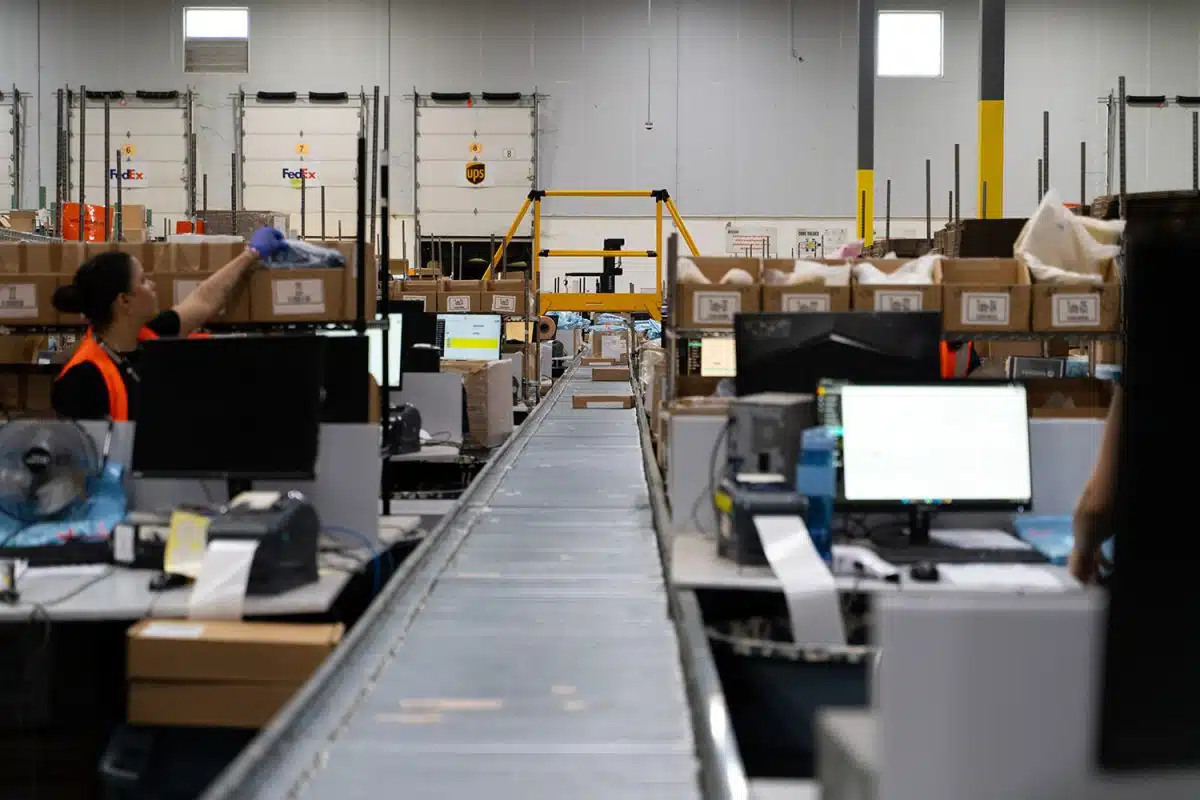
What an independent assessment taught me about transparency in third-party logistics.
Key Takeaways
- Boxzooka Founder & Chairman Brendan Heegan commissioned an independent assessment of the company’s proprietary warehouse management system (WMS), benchmarked against six leading fulfillment and WMS platforms.
- The review rated Boxzooka’s WMS at or above the leading platforms in the market across receiving, inventory, order fulfillment, and reporting.
- Boxzooka’s system connects to 82+ external platforms, well ahead of the 50-connection benchmark used in the assessment.
- Returns management, value-added services, and labor management stood out as particular strengths.
- Heegan argues that independent technology audits, not marketing claims, should be the standard eCommerce brands demand when they vet a 3PL partner.
Every 3PL I’ve ever competed against says some version of the same thing: our technology is different, our platform is better, we’re not like the others. I’ve said versions of that sentence myself, more times than I can count, in pitch meetings and on calls with brands trying to decide who to trust with their fulfillment. At some point I stopped being comfortable repeating it without proof.
The Trust Gap in 3PL Technology
That instinct isn’t unique to Boxzooka. Ninety percent of shippers say technology is a critical factor when choosing a 3PL, but only 57 percent are satisfied with what their current provider delivers. A separate 2025 NTT DATA survey found that 62 percent of shippers want to see change in their provider’s technology, trailing only supply chain visibility at 69 percent. Brands aren’t struggling to find 3PLs that say the right things. They’re struggling to find ones that can prove it.
Part of that is the Amazon effect. Brands that ship through Boxzooka are competing for the same customer who expects two-day delivery, real-time tracking, and an easy return, no matter who actually fulfills the order. A brand can’t deliver that experience on top of a fulfillment partner running outdated systems, so the technology question stopped being a nice-to-have line item and became the thing that determines whether a brand can even compete. That’s what puts retailers in the driver’s seat in this relationship. They’re not just buying warehouse space. They’re buying a technology stack, and they’re right to ask hard questions about it.
We built our own warehouse management system (WMS) in Boxzooka’s early days because the off-the-shelf options at the time weren’t built for how we wanted to run fulfillment for growth-stage eCommerce brands: real customization, seamless returns handling, total flexibility for brands with SKU depth and seasonal complexity. Owning the platform meant that whenever a client, or internal operations, needed a feature not typically available in an off-the-shelf WMS solution, my team could build it instead of waiting on a vendor’s development roadmap. That decision has paid off in countless meaningful ways over the years. But at the same time, nobody outside our own walls had ever really put our claims to the test.
That’s a familiar position for a lot of 3PLs, honestly. It’s easy to talk about “technology” in the abstract, as a bullet point on a sales deck, without ever putting a number next to it. I didn’t want to be in that position anymore, and I didn’t want our sales team fielding the same skeptical question in every deal without something real to point to.
So in late 2024, I commissioned West Monroe to come in and tell us the truth about our own platform. Not a marketing audit. A real one: dozens of hours inside our operations, a stack of technical documents, and a direct comparison against six of the leading fulfillment and WMS platforms in the industry, the same platforms our prospects evaluate us against in nearly every sales conversation.
I’ll be honest about why that’s not a common move. Once you invite outside experts in to grade your platform, you don’t get to pick which parts of the report you keep. If it had come back and said our technology was behind the market, I would have owed our team, and our clients, an honest reckoning with that. What matters here isn’t how rare I believed that risk to be. It’s that we were willing to put our own claims in front of the same scrutiny we’d want from a partner. I think that’s exactly why it was worth doing.
Here’s the thing: an outside review only means something if it’s structured the same way a prospect would evaluate us. So we didn’t let the firm grade us against our own roadmap or our own definition of success. We had them score us against the functions a warehouse actually has to perform every day, the ones that show up in an RFP whether the buyer knows the right vocabulary for them or not, and against real competitor platforms rather than a hypothetical industry average.
Where Our WMS Stood Out, and Where We Can Keep Improving
Our WMS was rated at or above the level of the leading platforms in the market across the functions that actually run a warehouse: receiving, inventory, order fulfillment, reporting. Three areas stood out specifically: returns management, value-added services, and labor management, the parts of the job that are hardest to fake and easiest to notice when they go wrong. And on integrations, the connections that keep a brand’s storefront, marketplaces, and ERP talking to their fulfillment partner, we came in well ahead of the category average: 82 direct connections against a benchmark of 50. You can see the current featured list on our 3PL WMS technology page.
None of that means we’re finished. The same assessment also identified real opportunities to continue strengthening the platform, and we’re already working through that list. I don’t think an independent assessment is something you do once and put on a shelf. I think it’s something you do on a schedule, the same way you’d audit your financials, because the alternative is finding out where you actually stand from a client instead of from your own team.
Those three standout areas aren’t random. Returns management is the part of fulfillment most 3PL’s neglect and brands underestimate until they’re living with a bad version of it: slow processing, no visibility into inventory condition, no clean path back to sellable stock. Value-added services, things like monogramming, kitting, custom packaging, and subscription-box assembly, are where a rigid platform shows its limits fastest, because they demand flexibility to effectively automate where a generic WMS falls short. And labor management determines whether daily SLA’s are met and if peak season is a controlled process or a scramble. Those are also the three areas our growth-stage eCommerce clients ask about most, in fashion, beauty, and subscription box specifically, so it’s not a coincidence that they’re where the assessment found the clearest daylight between us and the category.
I’d also rather be candid about what a report like this can’t tell you. It’s a snapshot of capability, not a guarantee of fit. A platform that scores well on paper can still be the wrong choice for a specific brand if the team running it doesn’t understand that brand’s category, or if the onboarding process doesn’t match how that brand actually operates. Great technology alone doesn’t make a great 3PL. This assessment is proof we take ours seriously, but it’s one part of the answer, not the whole answer, to whether we’re the right partner for you.
In short, transparency in this industry means inviting outside scrutiny before a client has to demand it.
Why the Stakes of Choosing a 3PL Are Higher Than They Used To Be
Ninety-four percent of domestic Fortune 500 companies now work with at least one 3PL, and U.S. 3PL revenue is estimated at $424.3 billion, according to Armstrong & Associates. Outsourcing logistics stopped being the question years ago. Choosing the right partner is the whole game now. Half of shippers say they’re consolidating the number of 3PL partners they use, according to the 2026 Third-Party Logistics Study, so each remaining relationship carries more weight than it used to. When 88 percent of shippers report their 3PL relationships are successful, the failures that do happen rarely come down to price. They come down to whether the technology actually does what the pitch deck said it would.
Price is the easiest thing for a prospective client to compare across proposals, and the hardest thing for a 3PL to differentiate on honestly. Technology transparency is different. It’s harder to fake, and it tends to predict the parts of the relationship that are hardest to fix after the contract is signed: how quickly problems get caught, how clearly they get communicated, and how much manual work your team ends up doing to compensate for gaps in your provider’s systems.
I see this most with growth-stage brands, the ones consolidating inventory, order management, returns, and sometimes labor planning into one partner’s systems for the first time. That’s exactly the moment when a WMS with weak integrations or thin reporting turns into a daily headache instead of a one-time decision. The brands that get burned aren’t usually the ones who asked too many questions up front. They’re the ones who didn’t ask enough.
What This Means When You’re Vetting a 3PL Partner
If you’re evaluating fulfillment partners, I’d ask every one of them the same questions I’d ask us. Not because the answers need to match ours, but because how specifically a provider answers tells you more than any pitch deck, including the ones I’ve given:
- How fast do you actually see your inventory? A dashboard that updates once a day isn’t real-time visibility, no matter what the sales page calls it.
- How fast do returns come back to sellable stock? This is one of the areas easiest to fake in a demo and hardest to fake once you’re a live client.
- Which of your systems does their WMS actually connect to? A vague “we integrate with most platforms” answer is worth a follow-up question with specific platform names.
- How do they plan labor for your peak? Ask what happens to your service levels in the four weeks a year that matter most.
- What happens when your order volume doubles? A provider that can’t answer this concretely hasn’t stress-tested its own systems.
We put together a longer breakdown of the exact questions to ask here, including the follow-up questions worth asking when the first answer sounds too smooth. The short version is this: ask, and don’t accept a generic answer to a specific question.
We built our WMS technology to run our own warehouses well, not to win an award. Having someone independent confirm that is proof we’re on the right track. If you’re evaluating a 3PL right now, ask us the same hard questions I’ve laid out here. We’d rather earn your business by answering them than by outspending everyone else on the pitch deck. Contact us today, and let’s get started.